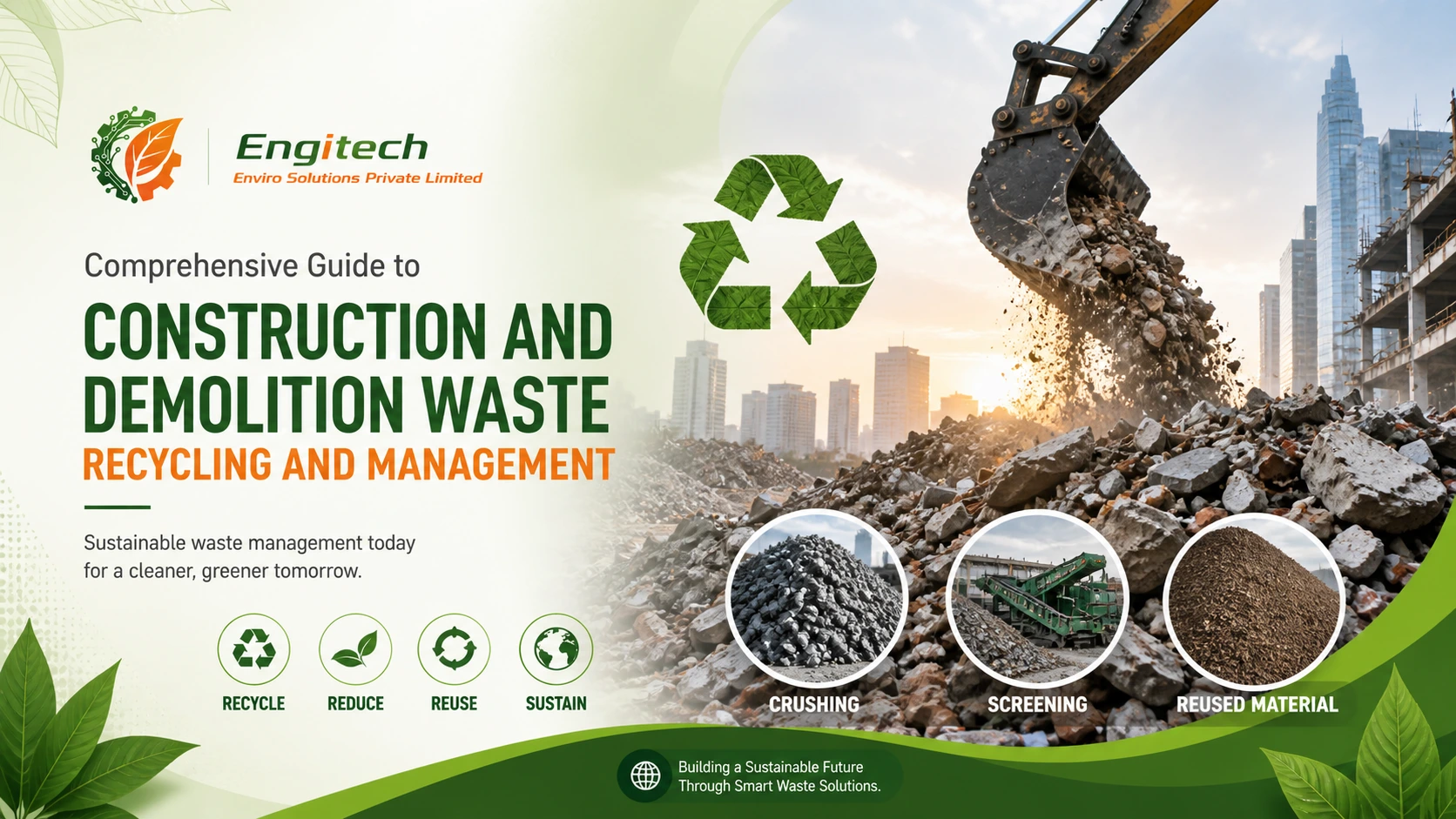
Urban areas and their infrastructure have expanded rapidly, creating difficulties in managing the vast waste generated by construction and demolition. At Engitech Enviro, we view sustainable waste management as our duty and as a chance to create an environmentally friendly future. A Comprehensive Guide to Construction and Demolition Waste Recycling and Management explains construction waste recycling and its significance, various methods, and real-world uses.
What is C&D Waste?
Before diving deeper, let’s understand what is C&D waste (Construction and Demolition waste).
C&D waste refers to materials generated during the construction, renovation, and demolition of buildings, roads, bridges, and other structures. This includes:
- Concrete
- Bricks
- Wood
- Metals
- Glass
- Plastics
- Asphalt
In simple terms, what is C&D waste? It is any debris produced from construction or demolition activities, often seen as useless but actually full of reusable potential.
Understanding Construction and Demolition Waste
Construction demolition waste is one of the largest waste streams globally. Improper disposal leads to:
- Environmental pollution
- Landfill overflow
- Resource depletion
- Increased carbon footprint
However, with proper construction and demolition waste recycling, these materials can be transformed into valuable resources.
Specifications for Construction and Demolition Waste Recycling Plant
| Parameter | Specification Details |
|---|---|
| Plant Capacity | 50 TPH – 500 TPH |
| Input Material | Concrete, Bricks, Asphalt, Demolition Waste |
| Output Material | Recycled Aggregates, Sand, Gravel |
| Feeding System | Hopper + Vibratory Feeder |
| Crushing Unit | Jaw Crusher / Impact Crusher |
| Screening System | Vibrating Screen (Multi-Deck) |
| Separation Technology | Magnetic Separator, Air Classifier |
| Automation Level | Semi-Automatic / Fully Automatic |
| Power Requirement | 75 kW – 500 kW |
| Dust Control System | Bag Filters / Water Spray System |
| Mobility Option | Stationary / Mobile Plant |
| Application Areas | Road Construction, Infrastructure Projects |
| Maintenance Requirement | Low Maintenance with Durable Components |
| Environmental Compliance | Pollution Control Norms Compliant |
Why Construction Waste Recycling is Important
Recycling is no longer optional—it’s essential. Here’s why construction waste recycling matters:
Key Benefits:
- Reduces landfill burden and saves space
- Conserves natural resources like sand, stone, and timber
- Lowers construction costs by reusing materials
- Minimizes environmental impact
- Promotes sustainable development
At Engitech Enviro, we focus on innovative solutions that turn waste into usable materials, helping industries adopt eco-friendly practices.
Types of Demolition Waste
Demolition waste varies depending on the structure being dismantled. Common categories include:
- Inert Materials: Concrete, bricks, tiles
- Recyclable Materials: Metals, wood, glass
- Hazardous Waste: Asbestos, chemicals, paints
Proper segregation is crucial for effective recycling and reuse.
Construction Waste Can Be Used For
Many people ask, ” Can construction waste be used for what? The answer might surprise you. Recycled materials have multiple applications:
Practical Uses:
- Road base and pavement construction
- Manufacturing new concrete and bricks
- Landscaping and filling material
- Drainage layers in construction projects
- Production of eco-friendly building blocks
Reusing these materials not only saves money but also reduces dependency on raw resources.
Process of Construction and Demolition Waste Recycling
The recycling process involves several steps to ensure efficiency and quality:
1. Collection and Transportation
Waste is collected from construction or demolition sites and transported to recycling facilities.
2. Segregation
Materials are sorted into categories such as concrete, metal, wood, and plastics.
3. Crushing and Processing
Concrete and bricks are crushed into smaller aggregates for reuse.
4. Screening and Filtering
Materials are refined to meet industry standards.
5. Reuse and Manufacturing
Processed materials are used in new construction projects or products.
Challenges in C&D Waste Management
Despite its benefits, managing construction demolition waste comes with challenges:
- Lack of awareness
- Poor segregation at source
- Limited recycling infrastructure
- High transportation costs
However, with advanced technology and better policies, these challenges can be overcome.
Role of Engitech Enviro in Waste Recycling
At Engitech Enviro, we are committed to transforming waste management practices through:
- Advanced recycling systems
- Sustainable engineering solutions
- Efficient waste processing technologies
- Eco-conscious project planning
Our goal is to make construction and demolition waste recycling more accessible, efficient, and environmentally responsible.
Benefits of Construction and Demolition Waste Recycling
- Reduces Landfill Waste – Minimizes the burden on landfills and saves valuable land space.
- Conserves Natural Resources – Reduces the need for new raw materials such as sand and stone.
- Cost-Effective Solution – Lowers construction and material costs.
- Environmental Protection – Decreases pollution and carbon emissions.
- Energy Saving – Recycling consumes less energy compared to producing new materials.
- Promotes Sustainability – Encourages circular economy and responsible resource usage.
- Improves Efficiency – Streamlines construction processes with reusable materials.
- Regulatory Compliance – Helps meet government norms for waste management.
Applications of Construction and Demolition Waste Recycling
- Road Construction – Recycled aggregates are widely used as base and sub-base material in road projects.
- New Building Materials – Processed waste is used to manufacture bricks, blocks, tiles, and concrete.
- Land Filling & Site Development – Suitable for leveling low-lying areas and land reclamation.
- Drainage Systems – Crushed materials are used for drainage layers and filtration systems.
- Pavement and Footpaths – Ideal for sidewalks, pathways, and urban landscaping projects.
- Infrastructure Projects – Used in bridges, highways, and large-scale construction works.
- Backfilling Material – Helps in filling trenches and foundation gaps.
- Eco-friendly Construction – Supports green building practices and sustainable architecture.
Future of Construction Waste Management
The future lies in circular economy practices where waste is not discarded but reused. Governments and industries are now focusing on:
- Mandatory recycling policies
- Green building certifications
- Smart waste management technologies
This shift will significantly reduce environmental impact and promote sustainable growth.
Conclusion
The modern infrastructure development process requires people to understand C&D waste, together with its correct recycling methods. Construction waste recycling serves two purposes: to decrease waste and to enhance waste management through environmentally friendly methods.
Engitech Enviro provides industrial sectors with advanced waste management solutions that enable them to convert their waste problems into environmentally sustainable business opportunities. Construction and demolition waste recycling enables us to create both buildings and an environmentally friendly future.