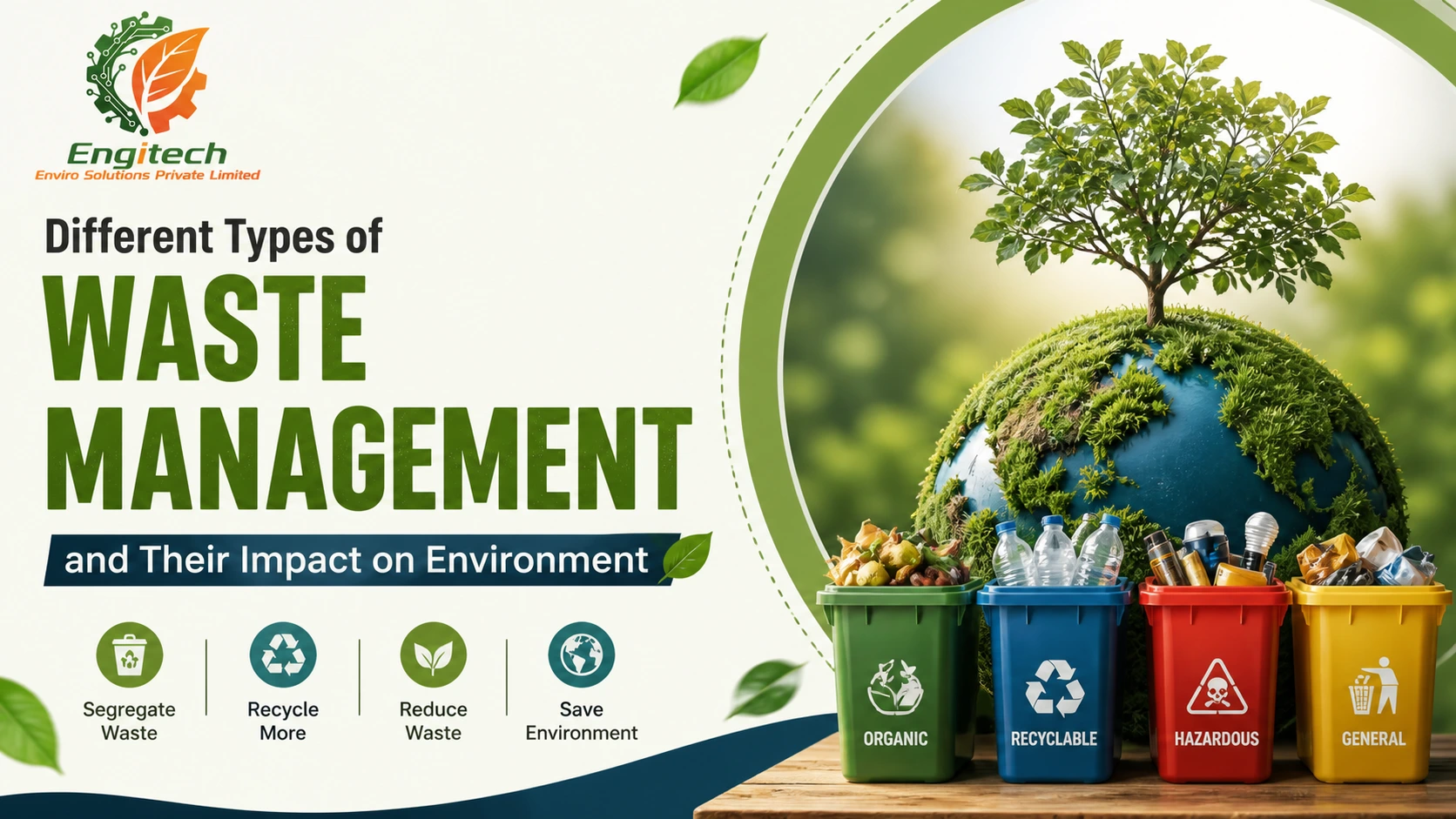
People need to manage waste because it exists in their daily lives, yet their waste management practices will determine which environmental outcomes will occur. The current waste generation rate continues to increase because urban areas expand, industrial activities develop, and people consume more products. Now, all types of waste must be handled according to proper methods because no organization can choose to ignore this requirement. Poor waste-management practices create severe environmental problems through their pollution of air and water, degradation of soil, and their dangerous impacts on human and animal health.
At Engitech Enviro, we believe that awareness and the right approach can transform waste from a burden into a valuable resource. When people and organizations grasp waste-management fundamentals and apply suitable waste processing techniques, their environmental effects become less damaging. Wastes modern waste-management system requires several steps, which begin with waste separation and continue through waste recycling and waste treatment, and finally end with waste disposal in an environmentally safe manner.
The blog examines various waste-management methods and their effects on environmental conditions throughout its content. The report demonstrates practical waste management methods that people can use in their daily activities and industrial work. The implementation of intelligent waste-management solutions will lead society toward a sustainable future that protects environmental resources for upcoming generations.
What is Waste Management?
The first step to understanding waste-management requires people to learn its definition. Waste management refers to the collection, transportation, processing, recycling, and disposal of waste materials in a way that minimizes harm to human health and the environment. The system handles all types of waste materials, which include both solid and liquid waste that comes from residential, commercial, and industrial waste streams.
Waste management systems exist to fulfill two purposes, which include waste elimination and the recovery of valuable resources while decreasing pollution and saving energy.
Importance of Waste Management
Improper waste disposal leads to serious environmental problems such as soil contamination, water pollution, and air toxicity. By adopting advanced waste management methods, we can:
- Reduce greenhouse gas emissions
- Prevent harmful chemicals from entering ecosystems
- Conserve natural resources
- Promote recycling and reuse
- Improve public health
Organizations like Engitech Enviro focus on providing sustainable solutions that align with environmental safety standards and long-term ecological balance.
Different Types of Waste Management Methods
There are several waste management techniques used globally. Each method has its own advantages and environmental impact.
1. Recycling
Recycling serves as the most popular approach for managing waste materials. The process transforms waste products into new items, which helps to decrease the need for raw materials.
Waste management methods include recycling of paper, plastic, glass, and metal materials. The method helps to preserve natural resources while decreasing the amount of waste sent to landfills. The process becomes less effective because of improper sorting and contamination issues.
Environmental Impact:
- Reduces landfill usage
- Saves energy
- Lowers carbon emissions
2. Composting
Composting serves as a natural method that transforms organic waste materials, including food leftovers, garden refuse, and biodegradable items into compost that contains essential nutrients.
Waste management definition method stands as one of the most environmentally friendly options available to both residential homes and farming operations.
Environmental Impact:
- Improves soil fertility
- Reduces methane emissions from landfills
- Promotes sustainable agriculture
3. Landfilling
Landfilling is the most traditional method of waste disposal. Waste is buried in designated landfill sites.
Although still widely used, it is considered less sustainable compared to modern waste management definition techniques.
Environmental Impact:
- Produces greenhouse gases like methane
- Risk of soil and groundwater contamination
- Requires large land areas
At Engitech Enviro, efforts are made to reduce dependency on landfills by promoting advanced waste processing solutions.
4. Incineration
Incineration involves burning waste at high temperatures to reduce its volume. It is commonly used for medical and hazardous waste.
This method is efficient in reducing waste size but must be carefully managed to control emissions.
Environmental Impact:
- Reduces waste volume significantly
- Generates energy (waste-to-energy systems)
- Can release harmful pollutants if not controlled
5. Waste-to-Energy (WTE)
Waste-to-energy is a modern approach among advanced waste management methods. It converts non-recyclable waste into usable energy, such as electricity or heat.
Waste management definition examples include power plants that burn waste to generate electricity.
Environmental Impact:
- Reduces landfill waste
- Provides alternative energy
- Requires proper emission control systems
6. Biological Treatment
This method uses microorganisms to break down organic waste. Techniques like anaerobic digestion fall under this category.
It is widely used in sewage treatment and agricultural waste processing.
Environmental Impact:
- Produces biogas as renewable energy
- Reduces organic waste volume
- Environmentally friendly
7. Source Reduction
Source reduction focuses on minimizing waste generation at the origin. It is one of the most effective waste management practices.
Examples include using reusable products, reducing packaging, and adopting eco-friendly materials.
Environmental Impact:
Promotes sustainable consumption
Reduces overall waste generation
Saves resources and energy
Impact of Waste Management on Environment
The choice of waste management techniques directly affects environmental health. Let’s understand how:
Positive Impacts
- Pollution Reduction: Proper waste handling prevents contamination of air, water, and soil.
- Resource Conservation: Recycling and reuse reduce the need for raw materials.
- Energy Savings: Many waste management methods, like recycling and WTE, conserve energy.
- Climate Protection: Reduces greenhouse gas emissions and global warming.
Negative Impacts (If Not Managed Properly)
- Landfills can leak harmful chemicals
- Incineration may release toxic gases
- Improper disposal leads to ecosystem damage
This is why companies like Engitech Enviro emphasize advanced and sustainable solutions that balance efficiency with environmental responsibility.
Practical Waste Management Examples
Understanding real-life waste management examples makes it easier to apply these methods:
- Households separating dry and wet waste
- Industries reusing scrap materials
- Cities implementing recycling programs
- Composting organic kitchen waste
- Using biodegradable packaging
These simple yet effective waste management practices can collectively make a big difference.
Waste Management – Detailed Specifications
| Category | Description |
|---|---|
| Definition | Waste management refers to collection, treatment, recycling, and disposal of waste in an eco-friendly manner. |
| Purpose | To reduce environmental impact, protect health, and conserve natural resources. |
| Types of Waste | Solid Waste, Liquid Waste, Organic Waste, Hazardous Waste, E-Waste |
| Waste Sources | Household, Industrial, Commercial, Agricultural, Medical |
| Waste Segregation | Separation of waste into biodegradable, non-biodegradable, and recyclable |
| Recycling Method | Converting waste materials like plastic, paper, and metal into reusable products |
| Composting Technique | Decomposition of organic waste into nutrient-rich compost |
| Landfill System | Disposal of waste by burying it in designated land areas |
| Incineration Process | Burning waste at high temperatures to reduce volume |
| Waste-to-Energy | Conversion of waste into electricity or heat |
| Biological Treatment | Use of microorganisms to break down organic waste |
| Environmental Benefits | Reduces pollution, conserves resources, lowers greenhouse gases |
| Health Benefits | Prevents diseases, improves sanitation, and ensures clean surroundings |
| Modern Techniques | Smart waste management, AI-based sorting, automated recycling systems |
| Sustainability Impact | Supports circular economy and long-term environmental protection |
| Best Practices | Waste management refers to the collection, treatment, recycling, and disposal of waste in an eco-friendly manner. |
Future of Waste Management
With increasing urbanization and industrialization, waste generation is rising rapidly. The future lies in adopting innovative waste management techniques such as:
- Smart waste segregation systems
- AI-based recycling solutions
- Zero-waste initiatives
- Circular economy models
At Engitech Enviro, the focus is on integrating technology with sustainability to create efficient waste handling systems for modern needs.
Conclusion
Waste management requires people to take environmental responsibility, which extends to their duty to protect upcoming generations. Our understanding of waste management allows us to study its definition together with different waste management methods, which we can apply through efficient waste management methods to achieve environmental protection goals.
The system requires every method to deliver essential operational functions, which include recycling, composting, and advanced waste-to-energy systems. The introduction of proper methods, together with public knowledge and expert assistance from Engitech Enviro, will enable us to create an environmentally friendly and lasting world.