The recycling industry and material processing sector depend on advanced separation technologies, which enable them to boost productivity while decreasing waste and achieving higher material purity. The air density separation system serves as a highly effective solution that multiple industries employ for their operations. The selection of appropriate separation technology for recycling plants, plastic processing facilities, food industries, and metal recovery operations will determine the operational efficiency and profitability of your business.
At Engitec Enviro, we understand the growing demand for advanced material separation systems. The blog will demonstrate how businesses can select their appropriate density separator by explaining how gravity separators and dry stoner machines function, their operational differences, and their various industrial applications and benefits.
What is an Air Density Separator?
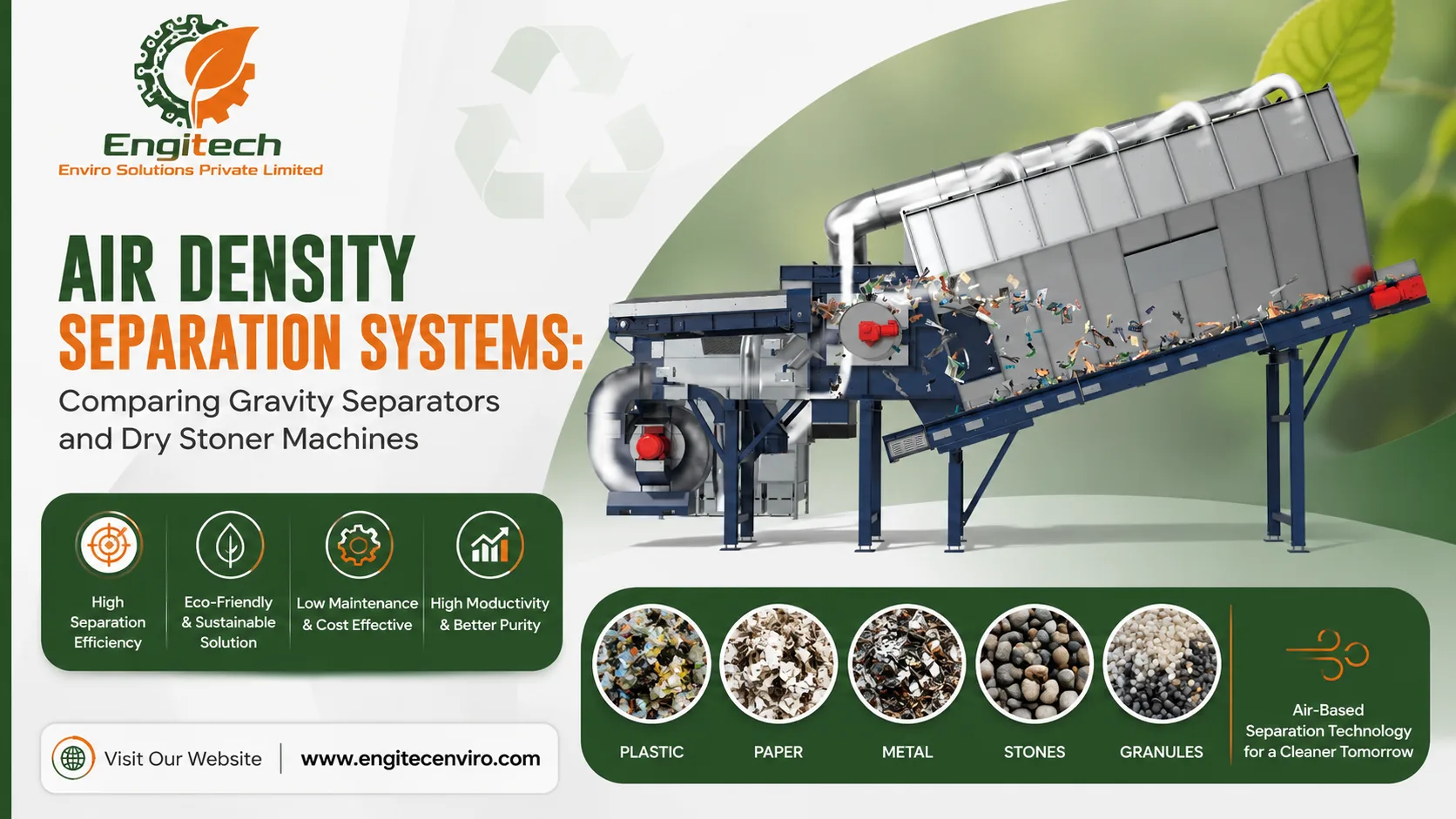
An air density separator is a machine designed to separate materials based on their weight, density, and aerodynamic properties using controlled airflow. The system uses a combination of vibration, air pressure, and gravity to separate light materials from heavier ones.
These systems are widely used in industries such as:
- Plastic recycling
- Waste management
- Food processing
- Mining
- Agriculture
- Electronic waste recycling
- Metal recovery
An advanced Air Density Separation machine helps businesses improve product quality while reducing contamination and manual labor costs.
Understanding Gravity Separators
A gravity separator is a type of density separation equipment that separates materials according to differences in specific gravity. It uses vibration, airflow, and inclined decks to move particles based on their density.
How Gravity Separators Work
The working principle is relatively simple:
- Material is fed onto a vibrating deck.
- Air flows upward through the deck.
- Heavy particles sink to the bottom.
- Lighter particles float and move separately.
- Different outlets collect separated materials.
This process enables accurate separation of materials that may appear visually similar but have different densities.
Common Applications of Gravity Separators
Gravity separators are widely used for:
- Removing stones from grains
- Separating plastic flakes
- Metal sorting
- Recycling operations
- Seed cleaning
- Mineral processing
Industries prefer gravity separators because they provide high precision and continuous operation with low maintenance requirements.
What is a Dry Stoner Machine?
A dry stoner machine is another type of density separator primarily used to remove heavier impurities like stones, metals, and dense contaminants from lighter materials.
Unlike wet separation methods, dry stoner systems operate without water, making them environmentally friendly and cost-effective.
Working Principle of Dry Stoner Machines
Dry stoner machines use:
- Airflow systems
- Vibratory motion
- Inclined separation decks
Heavy contaminants move upward while lighter products move downward, resulting in efficient separation.
Dry stoners are especially useful in food processing industries where moisture control is critical.
Gravity Separators vs Dry Stoner Machines
Although both technologies fall under the category of air density separator systems, they serve slightly different purposes.
| Feature | Gravity Separator | Dry Stoner Machine |
|---|---|---|
| Main Purpose | Density-based separation | Removal of stones/heavy impurities |
| Operating Medium | Air and vibration | Air and vibration |
| Water Requirement | No | No |
| Precision Level | High | Moderate to High |
| Applications | Recycling, plastics, minerals | Food grains, seeds, spices |
| Material Types | Wide range | Mostly agricultural products |
| Maintenance | Low | Low |
Both systems provide excellent efficiency, but selecting the right machine depends on the material type and processing requirements.
Benefits of Using Air Density Separator Machines
Modern industries are rapidly adopting Air Density Separation machines because of their numerous operational advantages.
1. High Separation Accuracy
Advanced systems can separate materials with very small density differences, improving product purity and recovery rates.
2. Eco-Friendly Operation
Since most systems work without water, they reduce environmental impact and water consumption.
3. Reduced Labor Costs
Automation minimizes the need for manual sorting, saving time and labor expenses.
4. Increased Productivity
Continuous processing capabilities allow industries to handle large volumes efficiently.
5. Versatile Applications
A single density separator can process multiple material types across industries.
Mobile Air Density Separator Systems
As industries move toward flexible and portable processing solutions, the demand for mobile Air Density Separation systems is increasing rapidly.
Why Mobile Systems are Popular
Mobile separators offer several benefits:
- Easy transportation
- On-site processing capability
- Lower transportation costs
- Faster deployment
- Ideal for temporary recycling sites
Many recycling companies now prefer mobile systems because they reduce the need to transport waste materials to centralized facilities.
Industries Using Mobile Air Density Separators
A mobile air density separator is commonly used in:
- Construction waste recycling
- Demolition waste processing
- Scrap metal recovery
- Plastic recycling
- Biomass separation
These systems are particularly beneficial for businesses operating at multiple locations.
Air Density Separator Market Trends
The global air density separator market is witnessing strong growth due to increasing industrial recycling activities and stricter environmental regulations.
Key Market Drivers
Growing Recycling Industry
The rise in plastic and electronic waste has increased the need for efficient separation systems.
Demand for Sustainable Technologies
Industries are shifting toward dry separation technologies to reduce water consumption and environmental impact.
Automation in Material Processing
Smart automation and sensor-based separation systems are improving operational efficiency.
Expansion of Circular Economy Practices
Governments and industries are encouraging recycling and resource recovery, boosting demand for density separation technologies.
The air density separator market is expected to continue expanding as industries seek cost-effective and eco-friendly waste management solutions.
Used Air Density Separator: Is It Worth Buying?
Many small and medium-sized businesses explore the option of purchasing a used air density separator to reduce initial investment costs.
Advantages of Buying Used Equipment
- Lower purchase cost
- Faster return on investment
- Availability of proven machine models
- Reduced depreciation
Things to Check Before Buying
Before purchasing a used air density separator, inspect:
- Machine condition
- Airflow efficiency
- Deck vibration system
- Maintenance history
- Motor performance
- Spare parts availability
Buying used equipment from a trusted supplier is essential to avoid unexpected operational issues.
Choosing the Right Density Separator
Selecting the ideal Air Density Separation machine depends on several important factors.
Material Characteristics
Different materials require different airflow settings and deck configurations.
Processing Capacity
Choose a machine that matches your production volume requirements.
Separation Accuracy
High-precision applications may require advanced gravity separators.
Space Availability
Compact and mobile systems are ideal for facilities with limited space.
Budget
Both new and used Air Density Separation options should be evaluated based on long-term operational value.
At Engitec Enviro, businesses can explore advanced separation technologies designed for modern industrial requirements.
Future of Air Density Separation Technology
The future of the Air Density Separation market is being shaped by innovation and automation.
Smart Automation
Modern machines now include:
- Sensor-based controls
- AI-driven sorting systems
- Remote monitoring
- Energy-efficient motors
Improved Energy Efficiency
Manufacturers are focusing on reducing power consumption while maintaining high separation efficiency.
Integration with Recycling Plants
Advanced separators are increasingly being integrated into fully automated recycling systems for continuous material recovery.
Maintenance Tips for Air Density Separation
Regular maintenance helps improve machine life and operational efficiency.
Important Maintenance Practices
- Clean airflow channels regularly
- Inspect vibrating decks
- Lubricate moving parts
- Monitor motor performance
- Replace worn-out filters
- Check air pressure settings
Preventive maintenance reduces downtime and improves overall productivity.
Why Industries Prefer Dry Separation Systems
Dry separation technologies are becoming increasingly popular because they eliminate water usage while maintaining high efficiency.
Key Advantages
- No wastewater generation
- Lower operating costs
- Easier installation
- Reduced environmental impact
- Faster material processing
This makes air density separator machines highly suitable for sustainable industrial operations.
Conclusion
The material separation processes of today depend on both gravity separators and dry stoner machines. The dry stoner machines provide effective, dense contaminant removal, while gravity separators deliver better precision for complex recycling and industrial applications.
The Air Density Separation market experiences growth because industries need efficient and eco-friendly automated separation technologies. The operational efficiency and material recovery rates of businesses improve when they choose the appropriate equipment for their needs, which includes stationary systems and mobile air density separators.