As environmental challenges continue to mount around the world, companies, industries, and people are now exploring more effective means of managing waste. One of the best strategies is employing the principles of the 7 R’s of waste management, which focus on reducing waste creation, conserving resources, and minimizing environmental degradation. At Engitech Enviro, we believe that adopting sustainable waste management practices is crucial to building a greener planet.
The 7R’s of waste management differ from typical waste recycling efforts. The strategy emphasizes the need to be mindful of consumption behavior, to avoid wasteful practices, and to adopt more environmentally friendly habits. Irrespective of whether you are an individual, a business owner, a retailer, or a municipal leader, the 7R philosophy is key to building a sustainable planet.
This article takes you through the 7 R’s of waste management – including what they entail, their benefits, how they can be implemented, and their importance in fostering sustainability.
Understanding the 7 R’s of Waste Management
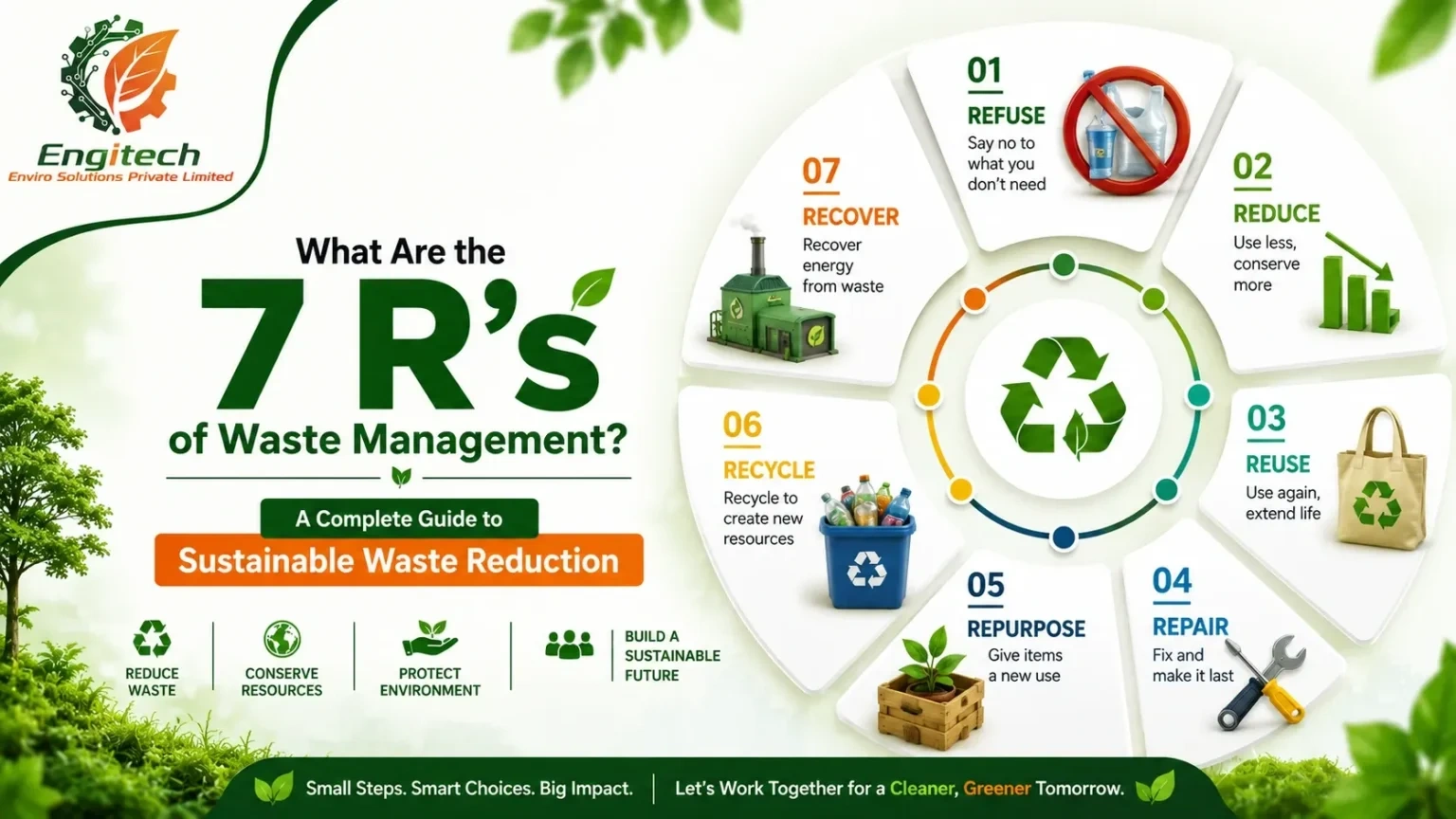
The 7 R’s of waste management are a set of principles aimed at reducing waste and maximizing resource efficiency. These r’s of waste management provide a structured approach to minimizing environmental impact while encouraging responsible consumption.
The seven Rs typically include:
- Refuse
- Reduce
- Reuse
- Repair
- Repurpose
- Recycle
- Recover
Together, these rs of waste management form a practical roadmap for sustainable living and efficient resource utilization.
1. Refuse – Say No to Unnecessary Waste
The first among the 7 R’s of sustainability involves refusing any products that cause wastage. Consumers can refuse to use things like plastics, excess packaging material, and disposable products.
One can manage their purchases through the application of the 7r’s concept, hence avoiding purchases that will lead to pollution in the environment. The art of refusing unnecessary things is one of the best ways of managing waste since waste is not created in the first place.
Companies can also help in making packaging sustainable.
2. Reduce – Minimize Resource Consumption
Another important aspect of the 7Rs of waste management is that of reduction in consumption. This means utilizing fewer resources, buying things that one really needs, and maximizing production techniques.
When organizations adopt the principle of 7R, they tend to reduce operational costs and become more efficient. By reducing waste production, there can be an effort towards living sustainably and reducing stress from waste management systems.
One of the most critical factors in reducing waste is through green technology applications.
3. Reuse – Extend Product Life
Using products is an important way to ensure that materials do not go to the landfill before they should. Reusable boxes, bottles, and products help in ensuring success with the 7 R’s of waste management.
Reuse plays a pivotal role in the 7 R’s of sustainability. This means that consumers have to make full use of products before disposing of them. With proper use of reuse, companies are able to increase the effectiveness of their product stewardship programs.
Sustainable packaging includes many instances in which the products are reusable for different uses.
4. Repair – Fix Instead of Discard
Repairing goods as opposed to buying new products, forms an important feature of the 7Rs of waste management. Goods like electronics, furniture, machinery, and appliances may last longer through maintenance.
Repairing goods according to the 7R feature ensures that consumers buy easily-repairable items, hence minimizing the need for new resources. As such, consumers adopt a sustainable way of living by reducing their purchases.
Product stewardship has become an emerging trend, and this has forced companies to come up with repair-friendly products.
5. Repurpose – Give New Life to Old Materials
Repurposing means using an object differently so that it does not have to be thrown away. It is one of the most creative solutions for dealing with waste.
For instance, wood pallets can be made into furniture, used packaging containers can become storage facilities, and industrial waste products can be made into something useful. This method proves that green technology can be applied successfully and shows the significance of the 7 R’s of sustainability.
Repurposing promotes the idea of resource saving and helps lead a more sustainable life.
6. Recycle – Convert Waste into Valuable Resources
Recycling continues to be among the most identifiable features within the 7 R’s of waste management since it entails converting waste products into useful products, therefore eliminating the need for fresh inputs.
Several intriguing facts about recycling illustrate the significance of this concept. For instance, recycling aluminum is known to cut the energy usage in making the material by up to 95%. Facts like these explain how recycling can help to conserve energy.
Companies that adopt the idea of sustainable packaging always use recyclable items to achieve their objective of maintaining a circular economy. As per the 7 R’s rule, recycling is a key component once refusal, reduction, reuse, repairing, and repurposing of products fail to work.
Other recycling facts indicate that recycling paper assists in protecting trees, saving energy, and water. Knowing these facts about recycling promotes the idea of waste reduction.
7. Recover – Extract Value from Waste
Recovery marks the final step among the 7 R’s of waste management. When materials are not reusable and recyclable, energy recovery techniques may be applied to change waste into energy.
The use of green technology has greatly contributed to the improvement of waste recovery mechanisms. Current waste-to-energy plants have the ability to create electricity while relying less on landfills.
Recovery goes hand-in-hand with product stewardship since waste materials should be properly handled during their entire life cycle. Recovery is one of the 7 R’s of sustainability.
Recycling Facts Everyone Should Know
Understanding important recycling facts can motivate individuals and organizations to improve their waste management practices.
Some interesting recycling facts include:
- Recycling one ton of paper can save thousands of gallons of water.
- Aluminum can be recycled repeatedly without losing quality.
- Glass is 100% recyclable and can be reused indefinitely.
- Many plastic products can be transformed into new packaging materials.
- Recycling reduces landfill waste and lowers carbon emissions.
These recycling facts illustrate why recycling remains a cornerstone of the 7 R’s of waste management and modern environmental strategies.
Product Stewardship and Sustainable Waste Management
Product Stewardship is an important concept that can go hand in hand with the 7R Principle since it emphasizes creating awareness about reducing environmental effects at each stage in the life cycle of a product among its producers, distributors, retailers, and even consumers.
Good Product Stewardship initiatives ensure that companies produce eco-friendly products and are able to handle their disposal as well as the recovery of materials effectively.
Product Stewardship and the 7Rs of Waste Management complement each other.
Application of Green Technology in Waste Management
The application of green technology has led to significant changes in the waste management sector. Smart sorting technologies, advanced recycling centers, energy from waste centers, and eco-friendly manufacturing techniques are all components of sustainable development.
The application of green technology plays an integral role in the process of the 7 R’s of waste management, starting from waste reduction to resource recovery. The application of green technology helps industries operate in an efficient manner without causing any damage to the environment through innovation.
Engitech Enviro understands the significance of the application of green technology in modernizing waste management.
Sustainable Packaging and Circular Economy
Sustainable packaging is another aspect that is enabling businesses to minimize their environmental impact. The growing use of recyclable, biodegradable, reusable, and compostable materials is a trend in the industry.
Incorporating sustainable packaging is an ideal fit for the seven R’s of sustainability. Many companies have begun adopting sustainable packaging practices as a way of reducing their waste management.
The inclusion of sustainable packaging alongside the 7R principle helps promote the development of a circular economy system.
How the 7 R’s Promote a Sustainable Lifestyle
Adopting the 7 R’s of waste management helps individuals develop a sustainable lifestyle by encouraging responsible consumption and waste reduction.
A sustainable lifestyle includes:
- Purchasing only necessary products.
- Choosing reusable alternatives.
- Supporting eco-friendly brands.
- Practicing recycling and composting.
- Reducing dependence on disposable items.
The 7Rs of waste management provide practical guidance for maintaining a sustainable lifestyle while reducing environmental impact.
Benefits of Following the 7 R’s of Sustainability
The 7 R’s of sustainability offer numerous environmental, economic, and social benefits:
- Reduced landfill waste.
- Conservation of natural resources.
- Lower carbon emissions.
- Increased recycling rates.
- Improved resource efficiency.
- Enhanced corporate responsibility.
- Support for circular economy practices.
By embracing the R’s of waste management, businesses and individuals can create lasting positive environmental change.
Conclusion
The 7 Rs of waste management serve as a complete approach to minimize waste and enhance sustainability. Through the implementation of the 7Rs concept, practicing the spirit of product stewardship, applying green technology, using sustainable packaging, and practicing a sustainable lifestyle, there will be considerable reductions made towards minimizing the impact on the environment.
In line with our goal at Engitech Enviro, we aim to encourage and support novel approaches to waste management, which are in tune with the concepts behind the 7 Rs of sustainability. Understanding and incorporating the 7Rs of waste management will lead us to a better future.