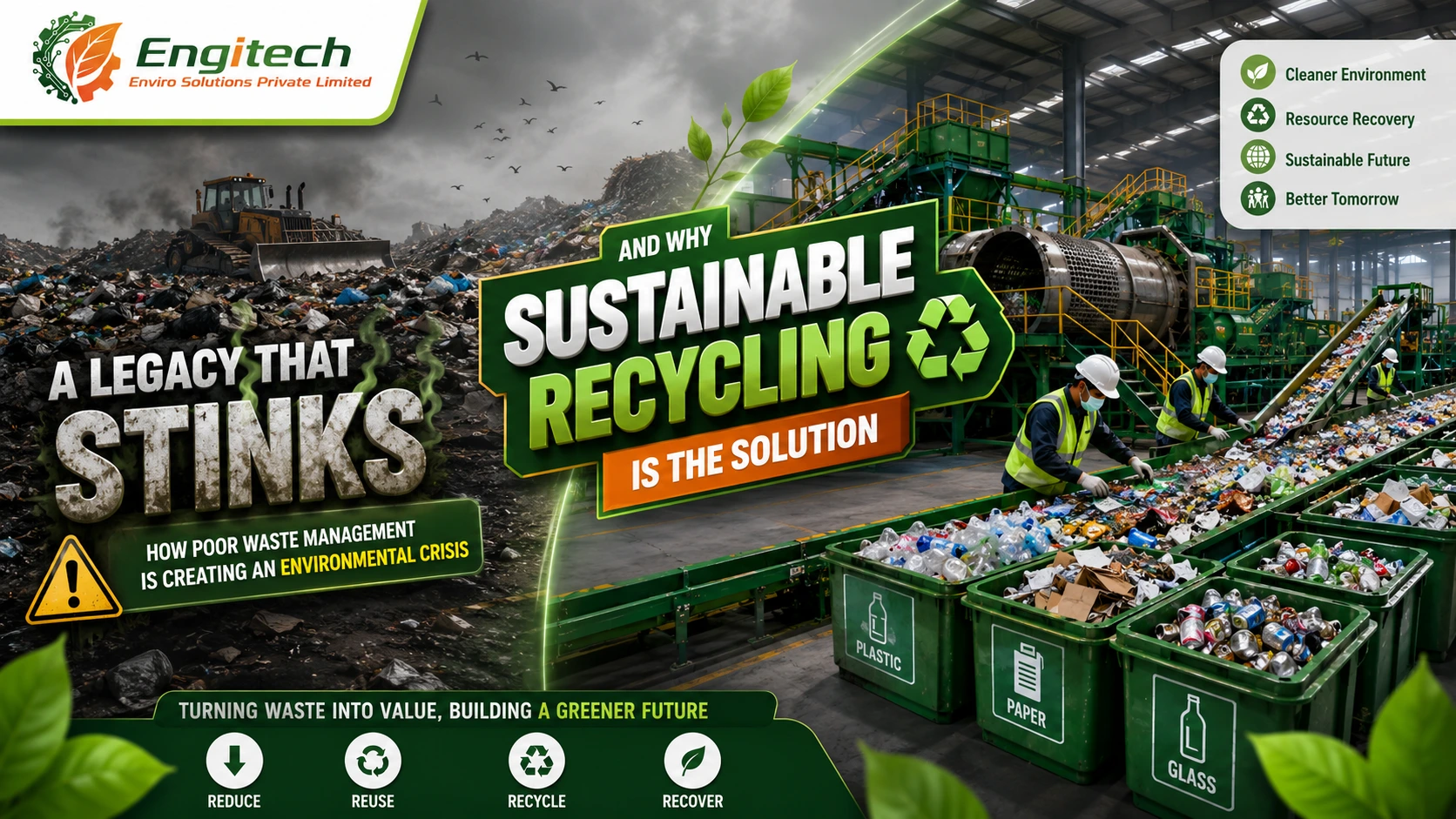
Consider passing by a landfill site that has existed for decades. The site is characterized by a terrible smell, toxic gases rising into the atmosphere, polluted groundwater, and mounds of garbage continually piling up daily. What most people may not be aware of is the fact that such dumping sites are not merely piles of garbage; rather, they are an environmental burden termed legacy waste. Each year, municipalities spend millions of dollars to deal with the waste problem, but there are still numerous cases of dumping sites that continue posing great dangers to public health and polluting resources.
It is not merely a question of waste collection but a major concern about how to handle decades of waste that have piled up without any action being taken against them. Overfilled landfills, increased methane production, water contamination, and decreased space for dumping have become a major issue.
The concept behind Engitech Enviro is that all waste management projects must first consider the customer’s environmental issues rather than suggesting machinery. Regardless of whether you are a municipal corporation, a private waste management service provider, an industry entity, or an environmental consultancy firm, your foremost aim must be to come up with sustainable, practical, and long-lasting solutions in order to protect the environment as well as the people. The use of modern recycling technology and waste processing techniques can turn the once abandoned wastelands into opportunities for restoring the environment.
Whether you have been wondering what is legacy waste, why it is known as legacy waste meaning, and how legacy waste management has gained much importance these days, this guide is here to explain the issue to you.
Understanding Legacy Waste
Before going into detail about possible remedies, it is essential to know the meaning of legacy waste.
It is quite simple, because by legacy waste one understands the accumulated municipal solid waste which was dumped on landfill sites for years and was not properly scientifically treated or processed. In contrast to newly created waste, legacy waste mostly contains mixed garbage which had accumulated for decades. Thus, it is significantly harder to restore and recycle it.
When one looks up what is legacy waste on the internet, he/she probably look for this particular type of waste.
The legacy waste meaning is more than simply old waste; it is indicative of a history of poorly planned waste management and an absence of waste management infrastructure and scientific waste processing systems. These dumpsites are still impacting the nearby residents with pollution, smell, diseases, and greenhouse gas emissions.
In today’s environmental discourse, the legacy waste management entails reclaiming these dumpsites through modern techniques such as bio-mining, bio-remediation, segregation of waste, materials recovery, compost recovery, and recycling.
Some users are interested in the legacy waste meaning in malayalam as well, particularly in areas where the local government is executing scientifically planned landfill projects. However, the environmental issue is identical all over the world – the need to process rather than dump waste sustainably.
Why Legacy Waste Has Become a Global Environmental Crisis
The world produces billions of tons of municipal solid waste every year. Unfortunately, for many decades, waste disposal simply meant dumping garbage in open landfills without segregation or recycling.
As cities expanded, these dumping grounds continued growing until they became massive environmental hazards.
Today, legacy waste is responsible for several serious challenges:
- Rapidly filling landfill sites
- Soil contamination
- Groundwater pollution
- Methane gas emissions
- Air pollution
- Fire hazards
- Disease-causing insects and rodents
- Unpleasant odor affecting nearby communities
- Loss of valuable land resources
- Reduced recycling opportunities
These issues explain why governments worldwide are investing heavily in legacy waste management projects.
Without scientific intervention, legacy waste continues to affect the environment for decades.
What Causes Legacy Waste?
Understanding the causes helps organizations prevent future waste accumulation while planning better waste management systems.
Some of the biggest reasons behind increasing legacy waste include:
Lack of Waste Segregation
When biodegradable waste, plastics, paper, metals, glass, and hazardous materials are mixed, recycling becomes extremely difficult.
Mixed waste eventually turns into legacy waste, making future recovery expensive and time-consuming.
Poor Recycling Infrastructure
Many cities lacked proper recycling facilities for decades.
Without sorting systems and recycling plants, waste was simply dumped into landfill sites.
Modern recycling facilities are now helping reduce future legacy waste generation.
Rapid Urbanization
Population growth directly increases waste generation.
Unfortunately, waste processing infrastructure has not always grown at the same pace.
This imbalance contributes significantly to increasing legacy waste accumulation.
Limited Public Awareness
Improper disposal practices remain one of the largest contributors to landfill growth.
When recyclable materials are discarded along with household waste, valuable resources are permanently lost.
Public participation remains an important part of successful legacy waste management strategies.
Environmental Impact of Legacy Waste
The environmental damage caused by legacy waste extends far beyond landfill boundaries.
Groundwater Contamination
Rainwater passing through old landfill sites produces contaminated liquid known as leachate.
Without proper collection systems, this polluted liquid enters underground water sources.
Groundwater contamination affects agriculture, drinking water quality, and surrounding ecosystems.
Air Pollution
Old landfill sites continuously release methane, carbon dioxide, hydrogen sulfide, and other harmful gases.
Methane is one of the strongest greenhouse gases contributing to climate change.
Reducing legacy waste helps lower greenhouse gas emissions significantly.
Soil Degradation
Years of uncontrolled dumping reduce soil fertility.
Chemical contaminants affect microorganisms responsible for maintaining healthy soil ecosystems.
As a result, surrounding agricultural productivity may decline.
Biodiversity Loss
Animals, birds, and insects are directly affected by poorly managed waste dumps.
Plastic pollution, contaminated water, and toxic chemicals threaten wildlife habitats.
Scientific legacy waste management helps restore ecological balance over time.
Public Health Risks Associated with Legacy Waste
The effects of legacy waste are not limited to the environment.
Communities living near landfill sites often experience increased health risks.
Some common concerns include:
- Respiratory illnesses
- Skin infections
- Eye irritation
- Waterborne diseases
- Mosquito breeding
- Rodent infestation
- Food contamination
- Poor air quality
- Increased healthcare costs
This is one reason why governments are prioritizing landfill remediation projects across many countries.
What Is Legacy Waste Management?
Many people understand the waste problem but are unsure about the actual solution.
Legacy waste management refers to the scientific process of reclaiming old landfill sites through waste excavation, segregation, resource recovery, recycling, compost stabilization, and safe disposal of residual waste.
Instead of leaving waste buried for decades, modern engineering focuses on recovering useful materials while minimizing environmental damage.
An effective legacy waste management project generally includes:
- Site assessment
- Waste excavation
- Screening
- Material recovery
- Metal separation
- Plastic recovery
- Compost stabilization
- RDF preparation where applicable
- Scientific disposal of inert materials
- Land reclamation
This systematic approach transforms unmanaged dumps into environmentally safer locations.
Why Recycling Is the Only Long-Term Solution
Cleaning old landfill sites is only one part of the solution.
Preventing future legacy waste requires strong recycling infrastructure.
Every recyclable plastic bottle, cardboard box, aluminum can, steel container, and paper product that is recovered today is one less item entering tomorrow’s landfill.
Modern recycling systems reduce pressure on landfill sites, conserve natural resources, lower carbon emissions, and support a circular economy where waste becomes a valuable resource instead of an environmental burden.
In the case of Engitech Enviro, we recognize that there is no single project in waste management that does not come with its own set of difficulties. We do not push for a one-size-fits-all strategy but try to understand the nature of the waste in question, the goal of the project, any environmental issues, and the sustainability objective.
Modern Technologies Used in Legacy Waste Management
Legacy waste disposal has gone beyond excavation of old landfills and relocation of the wastes to new sites. Modern engineering and scientific techniques can now be used to extract useful materials while improving the environment. Any good legacy waste disposal project will always begin with knowledge of the waste composition, landfill conditions, and environmental goals.
Some of the most widely used technologies include:
- Bio-mining
- Bio-remediation
- Trommel Screening
- Air Density Separation
- Magnetic Separation
- Eddy Current Separation
- Material Recovery Facilities (MRF)
- RDF (Refuse Derived Fuel) Preparation
- Compost Stabilization
- Scientific Land Reclamation
These technologies significantly improve recycling efficiency while reducing landfill dependency.
Step-by-Step Legacy Waste Management Process
Site Assessment and Environmental Survey
The first stage of legacy waste management involves conducting a detailed survey of the dumpsite. Engineers evaluate landfill volume, waste age, moisture content, available land, groundwater conditions, and environmental risks.
A proper assessment ensures the project is planned safely and efficiently.
Waste Excavation
Heavy equipment carefully excavates the accumulated legacy waste without disturbing nearby communities or damaging surrounding land.
The excavated waste is then transported to the processing area.
Primary Screening
Large trommel screens separate waste into different size fractions.
Fine particles usually contain soil-like material and partially decomposed organic matter, while larger fractions contain plastics, metals, glass, textiles, wood, and other recyclables.
This stage improves the efficiency of the complete legacy waste management process.
Material Recovery
After screening, recyclable materials are separated using both automated and manual sorting systems.
Recovered materials commonly include:
- Plastic
- Paper
- Cardboard
- Glass
- Aluminum
- Steel
- Rubber
- Textile
Recovering these materials reduces landfill volume while generating additional value through recycling.
Metal Separation
Powerful magnetic separators recover ferrous metals.
Eddy current separators recover aluminum and other non-ferrous metals.
These recovered metals are supplied to recycling industries for reuse.
RDF Preparation
High-calorific combustible materials that cannot be recycled are converted into Refuse Derived Fuel (RDF).
This alternative fuel helps reduce dependence on conventional fossil fuels while minimizing landfill disposal.
Compost Stabilization
Organic-rich fractions are biologically stabilized before being reused wherever suitable according to applicable environmental standards.
Scientific Disposal
Only inert materials that cannot be recovered or recycled are scientifically disposed of according to government regulations.
This ensures minimal environmental impact.
Land Reclamation
After complete processing, the reclaimed land can be safely utilized for green spaces, infrastructure development, or other approved public projects.
This is one of the biggest achievements of modern legacy waste management.
Why Sustainable Recycling Is the Future
Cleaning old dumping grounds is only half the battle.
Preventing future legacy waste depends on building strong recycling systems that recover materials before they reach landfills.
Sustainable recycling offers multiple long-term benefits:
- Reduces landfill dependency
- Conserves natural resources
- Lowers greenhouse gas emissions
- Reduces pollution
- Saves energy
- Improves public health
- Supports circular economy principles
- Creates employment opportunities
- Generates revenue from recyclables
- Protects ecosystems for future generations
Instead of treating waste as garbage, sustainable recycling transforms it into a valuable resource.
This shift is becoming the foundation of modern environmental protection strategies.
Technical Specification Table for Legacy Waste Management Plant
| Specification | Details |
|---|---|
| Plant Type | Legacy Waste Bio-Mining & Recycling Plant |
| Waste Type | Legacy Municipal Solid Waste |
| Processing Capacity | 50 TPD – 1000+ TPD (Customizable) |
| Feeding System | Hopper with Belt Conveyor |
| Screening Equipment | Trommel Screen |
| Material Recovery | Manual & Automated Sorting |
| Metal Recovery | Magnetic Separator & Eddy Current Separator |
| Air Separation | Air Density Separator |
| Plastic Recovery | Manual & Optical Sorting |
| RDF Preparation | Available (Optional) |
| Dust Control | Dust Suppression & Collection System |
| Control System | PLC-Based Automation (Optional) |
| End Products | Soil Fraction, Plastic, Metal, Glass, RDF & Recyclables |
| Applications | Municipal Corporations, Smart Cities, Industrial Waste Projects |
| Customization | Available as Per Site Requirements |
Note: Plant specifications vary depending on landfill age, waste composition, moisture content, processing capacity, and project objectives.
Working Process of Legacy Waste Management
The legacy waste management process is a scientific and systematic approach used to reclaim old landfill sites, recover valuable materials, and minimize environmental pollution. Instead of simply shifting decades-old waste from one location to another, modern legacy waste management focuses on converting waste into reusable resources while restoring land for future use. Every stage is carefully planned to maximize recycling, reduce landfill dependency, and ensure compliance with environmental regulations.
1. Site Assessment and Waste Analysis
The process begins with a detailed survey of the landfill. Experts assess the age of the waste, total dump volume, moisture content, waste composition, available land, and surrounding environmental conditions. This analysis helps determine the most suitable treatment and recovery methods.
2. Excavation of Legacy Waste
Heavy-duty excavators and loaders carefully remove the accumulated legacy waste from the dumpsite. The excavated waste is transported to the processing area, where it undergoes scientific segregation and treatment.
3. Screening and Size Separation
The excavated waste is fed into a Trommel Screen, which separates materials based on particle size. Fine soil-like material, organic fractions, plastics, metals, glass, and larger waste components are divided into different streams, making the recovery process more efficient.
4. Material Recovery and Segregation
Recovered waste passes through manual and automated sorting systems. Valuable recyclable materials such as plastics, paper, cardboard, glass, metals, textiles, and wood are separated for further processing. This stage significantly reduces the amount of waste sent back to landfills.
5. Metal Recovery
Magnetic separators remove ferrous metals such as iron and steel, while eddy current separators recover non-ferrous metals like aluminum. These materials are then supplied to recycling industries for manufacturing new products.
How to Select the Right Legacy Waste Management Solution
Every landfill is different.
The age of waste, local climate, available land, moisture levels, and waste composition all influence the treatment process.
Before planning a project, organizations should evaluate:
- Daily processing requirement
- Total landfill volume
- Available project area
- Recovery targets
- Recycling infrastructure
- Environmental regulations
- Future expansion plans
- Equipment maintenance
- Operating costs
- Sustainability goals
We know at Engitech Enviro that every landfill comes with its own set of challenges. It is not just about supplying equipment; it is about assisting different municipalities, industries, and environmental bodies in finding solutions to their problems. Through scientifically planned and sustainable waste management techniques, we make sure to convert their waste management issues into an opportunity.
Conclusion
The growing problem of legacy waste cannot be put off any longer. Each landfill left unclosed means years of wasted resources, pollution of the environment, public health threats, and lost recycling chances. The definition of what is legacy waste and the importance of legacy waste management becomes clear when governments, industries, and communities understand that sustainable waste processing is necessary for further protection of the environment.
Some people also look for legacy waste meaning in Malayalam, trying to understand governmental landfill remediation programs in their language, but whatever language you use, the goal is the same – to recover resources, reduce pollution, and reutilize lands safely.
Modern technologies such as recycling, bio-mining, landfill remediation, and material recovery help modern cities to substitute old dumping systems with the sustainable waste management practices. With proper planning and an engineering approach, old dumpsites can become more useful and cleaner places.
At Engitech Enviro, we are sure that the future of waste management is in innovations, in environmental responsibility, and in customer-oriented solutions. Knowing the peculiarities of every project and offering scientifically proven methods of recycling, we want to help organizations to build clean and sustainable cities of the future.
Frequently Asked Questions
1. What is legacy waste?
Legacy waste refers to old municipal solid waste that has accumulated in landfill sites or open dumps over many years without proper scientific processing or recycling.
2. What is the legacy waste meaning?
The legacy waste meaning refers to historical waste deposits that continue to create environmental and public health problems due to improper disposal practices followed in the past.
3. Why is legacy waste management important?
Legacy waste management helps recover recyclable materials, reduce landfill pollution, reclaim valuable land, lower greenhouse gas emissions, and improve environmental sustainability.
4. What is legacy waste meaning in Malayalam?
The legacy waste meaning in malayalam refers to the same concept of old accumulated waste stored in dumping grounds that requires scientific treatment through bio-mining, recycling, and landfill remediation. The terminology may be translated differently, but the environmental objective remains unchanged.
5. What is the best solution for legacy waste?
The most effective solution combines bio-mining, waste segregation, recycling, material recovery, RDF preparation, compost stabilization, and scientific disposal of residual inert materials.
6. How does sustainable recycling reduce legacy waste?
Sustainable recycling prevents recyclable materials from entering landfills, conserves natural resources, reduces pollution, minimizes landfill expansion, and significantly decreases future legacy waste accumulation.