With the rise of rapid urbanization in the current age, cities and industries produce millions of tons of solid waste annually. Proper waste management has ceased to be a mere choice; instead, it is a necessity in our environment. With poor management of waste, we can see overfilled landfills, a polluted environment, the emission of greenhouse gases, and health risks to people. And that is where technological advancements in waste processing come into play. One such advancement is the Municipal Solid Waste (MSW) Shredder Machine, which is currently indispensable for efficient waste management of our times. By shrinking the amount of waste, enhancing its separation and preparation of materials for the recycling process, the use of an MSW shredder increases the effectiveness of recycling facilities and makes the whole process of waste processing easier. No matter whether it is plastic, paper, wood, textile, rubber, cardboard, organic waste or mixed municipal waste – shredding of waste greatly improves the recycling process overall.
Engitech Enviro recognizes that sustainable waste management starts with the use of robust and highly effective machinery. Our modern solutions for waste management machines have been engineered keeping in mind the increasing needs of municipal corporations, the recycling industry, waste-to-energy facilities, the cement industry, and material recovery facilities. Today’s waste management system is much more than simply getting rid of waste; it is about resource recovery, less dependence on landfills, and creation of a circular economy in which waste becomes a valuable resource. The following guide will give you detailed information about Municipal Solid Waste Shredder Machines. It will tell you all about working, applications, advantages, disadvantages, industrial uses, and much more.
What is a Municipal Solid Waste Shredder Machine?
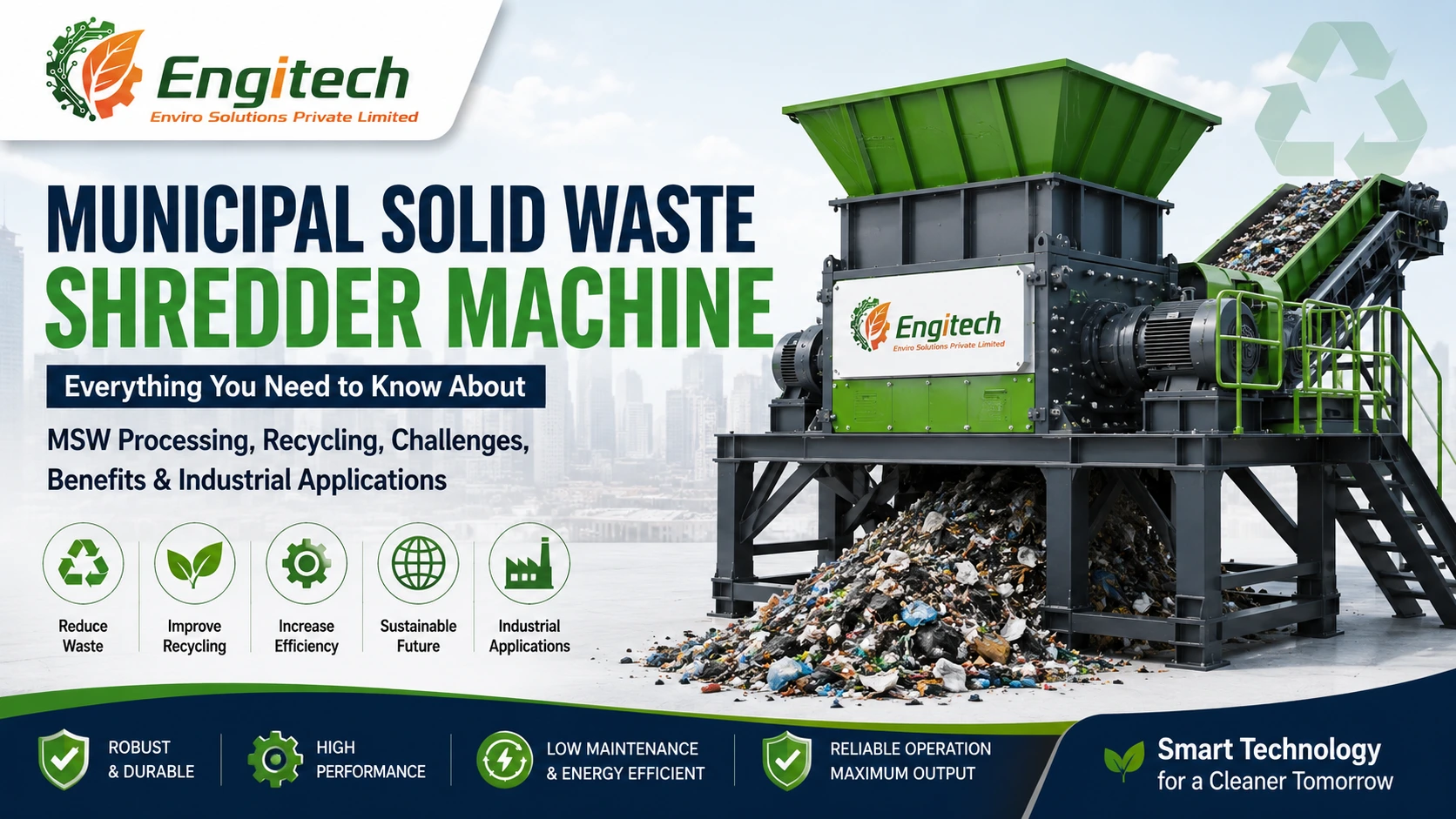
An MSW (Municipal Solid Waste) Shredder Machine refers to a robust piece of industrial machinery that reduces mixed municipal solid waste into small pieces for processing, recycling, composting, or energy generation. Mixed municipal solid waste is defined as the collection of materials that are typically discarded daily by residents, commercial enterprises, institutions, and public agencies. Such materials may include plastics, cardboard, paper, food, fabrics, wood, leather, rubber, organic garden waste, packaging products, and many other non-dangerous solid wastes.
Unlike common crushing machines, the MSW shredder uses rotating shafts fitted with specially designed blades that slice waste materials into smaller sizes. Smaller-sized waste materials make sorting easier, transportation simpler, recycling faster, and improve the overall efficiency of downstream equipment.
Modern plants employ an industrial garbage shredder to reduce mixed municipal solid waste before segregation to ensure easy handling on conveyor belts, magnetic sorters, air classifiers, and optical sorters.
Why Municipal Solid Waste Processing Matters
The world’s urban population continues to grow, resulting in a dramatic increase in municipal waste generation. Without proper processing systems, cities face serious environmental challenges including overflowing landfills, groundwater contamination, foul odors, methane emissions, and increased disease risks.
Effective MSW processing provides several environmental and economic advantages:
- Reduces the volume of waste entering landfills.
- Improves recycling efficiency.
- Increases recovery of reusable materials.
- Supports waste-to-energy projects.
- Reduces transportation costs.
- Minimizes greenhouse gas emissions.
- Conserves valuable natural resources.
- Promotes sustainable urban development.
Modern municipalities now focus on integrated waste management strategies where waste is viewed as a valuable resource rather than useless garbage.
Understanding Shredding in Solid Waste Management
One of the most important stages in modern recycling is shredding in solid waste management. Waste generated from different sources is irregular in size, shape, and composition. Processing such mixed waste directly is difficult and inefficient.
Shredding reduces bulky waste into uniformly sized particles, making downstream operations significantly more efficient.
The shredding of waste offers multiple operational advantages:
- Easier material separation
- Better recycling efficiency
- Faster composting
- Improved RDF production
- Higher fuel quality for waste-to-energy plants
- Reduced storage requirements
- Safer material handling
- Lower transportation costs
Without proper shredding, recycling plants often experience conveyor blockages, inefficient sorting, equipment damage, and increased maintenance costs.
How Does a Municipal Solid Waste Shredder Machine Work?
The working principle of an MSW shredder is simple yet highly effective.
Waste materials are loaded into the feeding hopper either manually or through conveyor systems. Once inside the shredding chamber, rotating shafts equipped with hardened steel blades grip and tear the waste into smaller pieces.
Depending on machine design, one or more shafts rotate at controlled speeds while generating high torque. This combination allows the shredder to process both soft and hard materials efficiently.
The shredded material then passes through discharge conveyors where it moves toward:
- Magnetic separators
- Air classifiers
- Optical sorting systems
- Composting units
- RDF production plants
- Waste-to-energy facilities
- Recycling plants
This systematic workflow significantly increases the efficiency of complete waste processing operations.
Major Waste Materials Processed by MSW Shredders
A modern solid waste shredder is capable of processing a wide variety of waste materials, including:
Household Waste
- Food packaging
- Paper
- Plastic bottles
- Cardboard
- Cloth
- Leather
- Wood
Commercial Waste
- Office paper
- Packaging waste
- Plastic containers
- Wooden pallets
- Cartons
Industrial Waste
An advanced industrial waste grinder can process:
- Plastic drums
- Rubber products
- Industrial packaging
- Wooden crates
- Textile waste
- Foam
- Fabric rolls
Construction Waste
Many industries also use specialized machines similar to a drywall shredder for reducing gypsum boards, insulation materials, wooden panels, plasterboard waste, and lightweight construction debris before recycling.
Key Components of a Municipal Solid Waste Shredder
A high-performance shredder consists of several precision-engineered components that work together to ensure smooth and continuous waste processing.
Heavy-Duty Hopper
The hopper allows safe and continuous feeding of mixed waste materials into the shredding chamber.
High-Torque Cutting Shafts
These shafts rotate slowly but generate enormous cutting force, allowing them to process bulky and difficult waste.
Hardened Alloy Steel Blades
Specially heat-treated blades perform tearing, cutting, and shearing operations while maintaining long service life.
Gearbox
The industrial gearbox converts motor speed into the high torque required for efficient waste shredding.
Powerful Electric Motor
The motor supplies the mechanical energy needed to rotate the cutting shafts.
Control Panel
Modern PLC-based control systems monitor machine performance, overload protection, emergency stops, and automatic reverse functions.
Discharge Conveyor
The conveyor transfers shredded material to the next stage of waste processing.
Importance of Industrial Waste Shredders in Modern Recycling
Today’s recycling industry depends heavily on industrial waste shredders because manual waste processing is no longer practical.
Industrial shredders improve:
- Material recovery rates
- Recycling plant productivity
- Operational safety
- Fuel production
- Waste handling efficiency
- Automation
- Resource recovery
They also reduce labor dependency while increasing plant throughput.
Benefits of Using an Industrial Garbage Shredder
Installing an industrial garbage shredder provides long-term operational advantages for municipalities, industries, and recycling companies.
Improved Waste Volume Reduction
Shredding decreases waste volume by up to 70%, reducing transportation and landfill costs.
Better Recycling Efficiency
Uniform particle size improves sorting and material recovery.
Enhanced Waste-to-Energy Production
Smaller waste particles burn more efficiently in RDF and waste-to-energy plants.
Lower Operational Costs
Reduced manual handling lowers labor expenses and increases productivity.
Increased Equipment Protection
Proper shredding minimizes damage to downstream processing equipment.
Environmentally Friendly Operation
Reduced landfill disposal supports sustainable waste management practices and lowers carbon emissions.
Types of Municipal Solid Waste Shredder Machines
Every waste processing facility has unique operational requirements, making it essential to choose the right shredding equipment. The capacity, type of waste, particle size requirements, and downstream processing determine which shredder is most suitable. Modern waste processing plants use different types of shredders to maximize productivity while minimizing operational costs.
1. Single Shaft MSW Shredder
A single shaft shredder is designed for processing lightweight to medium-density municipal waste. It uses one rotating shaft equipped with durable cutting blades and a hydraulic pusher that continuously feeds the material toward the cutting chamber.
Best For:
- Plastic waste
- Paper
- Cardboard
- Textile waste
- Wood
- Packaging materials
Advantages
- Uniform particle size
- Low maintenance
- Energy efficient
- Easy blade replacement
- High processing accuracy
2. Double Shaft MSW Shredder
A double shaft MSW shredder features two counter-rotating shafts fitted with interlocking cutters that tear bulky waste into smaller pieces. It is one of the most widely used machines in municipal waste management.
Suitable for:
- Mixed municipal waste
- Plastic drums
- Wooden pallets
- Rubber products
- Household garbage
- Industrial packaging
- Organic waste
Benefits
- High torque output
- Handles bulky materials
- Continuous operation
- Lower operating costs
- Excellent durability
3. Four Shaft Industrial Waste Shredder
A four-shaft machine is designed for industries that require extremely fine shredding. Multiple shafts allow more cutting points, resulting in consistent output size.
This type of industrial waste shredder is commonly used in recycling plants where particle size plays a crucial role.
4. High-Speed Industrial Waste Grinder
An industrial waste grinder is specially developed for reducing organic waste, food waste, biomass, wooden products, and mixed industrial waste into fine particles.
These machines improve composting efficiency and accelerate biomass processing.
5. Specialized Drywall Shredder
Construction and demolition waste often contains gypsum boards, insulation panels, plywood, and wall materials. A drywall shredder is engineered to process these materials efficiently while preparing them for recycling or landfill reduction.
Industrial Applications of Municipal Solid Waste Shredder Machines
Today, almost every municipal solid waste processing industry relies on advanced shredding systems. Their ability to reduce municipal solid waste volume, improve recycling efficiency, and increase resource recovery makes them an essential investment.
Municipal Waste Processing Plants
City corporations use MSW shredders to reduce mixed waste before segregation and recycling.
Material Recovery Facilities (MRFs)
Shredded waste improves the performance of sorting equipment, helping recover valuable recyclable materials more efficiently.
Waste-to-Energy Plants
Uniformly shredded waste burns more consistently, producing higher-quality Refuse Derived Fuel (RDF) and increasing energy generation efficiency.
Recycling Industries
Plastic, paper, rubber, textile, and metal recycling plants use shredders to prepare raw materials for further processing.
Cement Industries
Processed municipal solid waste is converted into RDF fuel, replacing conventional fossil fuels in cement kilns. Biomass Processing Plants
Organic waste is shredded before composting or biofuel production, improving decomposition rates and reducing processing time.
Common Challenges in Municipal Waste Shredding
Although shredding technology has significantly improved waste management, processing mixed municipal solid waste still presents several operational challenges.
Mixed Waste Composition
Municipal solid waste contains plastics, food waste, metals, glass, textiles, wood, and organic materials. Processing all these materials together requires a robust machine capable of handling varying densities and hardness levels.
Solution:
Use heavy-duty multi-shaft shredders equipped with high-strength alloy steel cutters and automatic overload protection.
Blade Wear
Continuous processing of abrasive materials gradually reduces blade sharpness, affecting shredding efficiency.
Solution:
Choose wear-resistant blades manufactured from hardened alloy steel and follow a preventive maintenance schedule.
Machine Overloading
Large metal objects or oversized waste can overload the machine and interrupt operations.
Solution:
Install automatic reverse functions, overload sensors, and pre-sorting systems to remove heavy contaminants before shredding.
High Moisture Waste
Organic municipal waste often contains high moisture content, leading to material sticking inside the shredding chamber.
Solution:
Use specially designed cutters with self-cleaning features and maintain regular chamber inspections.
Energy Consumption
Large shredders consume considerable power when processing bulky waste continuously.
Solution:
Modern energy-efficient motors, variable frequency drives (VFDs), and optimized blade designs help reduce electricity consumption.
Technical Specification Table of Municipal Solid Waste Shredder Machine
| Specification | Details |
|---|---|
| Machine Type | Municipal Solid Waste Shredder Machine |
| Shredding System | Single Shaft / Double Shaft / Four Shaft |
| Motor Power | 30 HP – 250 HP (Customizable) |
| Capacity | 500 Kg/Hr – 20 Tons/Hr |
| Blade Material | Hardened Alloy Steel |
| Blade Hardness | HRC 58–62 |
| Shaft Material | High-Strength Forged Steel |
| Cutting Chamber | Heavy-Duty Fabricated Steel |
| Feeding System | Hopper / Conveyor Feeding |
| Drive System | Gearbox Driven |
| Output Size | Customizable (20–150 mm) |
| Automation | PLC Based Control Panel |
| Safety Features | Emergency Stop, Overload Protection, Auto Reverse |
| Power Supply | 415V, 3 Phase, 50 Hz |
| Application | Municipal Waste, Plastic, Paper, Wood, Rubber, Textile, Organic Waste |
Working Process of Municipal Solid Waste Shredder Machine
Step 1: Waste Collection
Municipal solid waste such as plastic, paper, cardboard, textiles, wood, rubber, food waste, and other mixed materials is collected from residential, commercial, and industrial sources and transported to the waste processing facility.
Step 2: Waste Feeding
The collected waste is loaded into the shredder’s hopper manually or through a conveyor system, ensuring a continuous and uniform material flow into the machine.
Step 3: Material Inspection & Pre-Sorting
Large metal objects, stones, or oversized materials are removed using magnetic separators or manual inspection to protect the shredder from damage and ensure smooth operation.
Step 4: Shredding Process
Inside the shredding chamber, high-torque rotating shafts fitted with hardened alloy steel blades grip, tear, cut, and shear the waste into smaller, uniform-sized particles for easier handling and processing.
Step 5: Size Reduction
The waste is reduced to the required particle size, making it suitable for downstream recycling, composting, RDF production, or waste-to-energy applications.
Step 6: Material Separation
The shredded material passes through sorting systems such as magnetic separators, air classifiers, trommel screens, and optical sorters to separate recyclable materials like metals, plastics, paper, and organic waste.
Step 7: Recycling or Resource Recovery
Recovered materials are sent to recycling plants, composting units, biomass facilities, or waste-to-energy plants where they are converted into reusable raw materials, compost, or alternative fuel.
Step 8: Final Waste Disposal
Only the non-recyclable and non-recoverable waste is safely disposed of in sanitary landfills, significantly reducing landfill volume and supporting sustainable waste management practices.
Why Choose Engitech Enviro?
The selection of an appropriate equipment vendor is as crucial as the machine itself. At Engitech Enviro, we pride ourselves on developing novel and dependable solutions for waste processing applications that facilitate increased efficiency in industrial processes while ensuring sustainable environmental management.
The Municipal Solid Waste Shredder Machines from Engitech Enviro have been designed using superior quality raw materials, the latest manufacturing technologies, and precise cutting technology to provide consistent performance in harsh industrial conditions. Whether your requirements involve municipal solid waste, industrial waste, plastic recycling, biomass processing, waste-to-energy conversion projects, etc., we have the solution for you!
Why Customers Trust Engitech Enviro
- Advanced engineering and durable machine construction
- High-performance cutting technology
- Energy-efficient operation
- Custom machine configurations
- Heavy-duty alloy steel cutters
- Low maintenance requirements
- Easy operation with PLC automation
- Reliable after-sales support
- Custom capacities for different industries
- Cost-effective waste management solutions
Our goal is to help industries convert waste into valuable resources while improving recycling efficiency and reducing environmental impact.
Conclusion
Municipal solid waste management has become extremely significant as cities around the world grow in numbers and waste continues to increase every year. Conventional waste disposal practices are not good enough when it comes to meeting regulatory requirements and sustainability considerations. Many approaches can be adopted for better solid waste management, and the installation of efficient solid waste shredders is among the best.
Modern technologies like industrial waste grinder, industrial garbage shredder, and advanced industrial waste shredders have made it easier for industrialists to manage mixed municipal waste efficiently and safely. From volume reduction to increased recovery of recyclable materials and contribution towards waste-to-energy projects, this equipment helps us build a better future.
At Engitech Enviro, we are dedicated to providing reliable waste management machine solutions that meet the evolving needs of municipalities, recycling facilities, and industrial sectors. With robust construction, advanced cutting systems, and customizable configurations, our shredders help organizations optimize operations while contributing to responsible municipal solid waste management and environmental conservation.
Frequently Asked Questions (FAQs)
1. What is a Municipal Solid Waste (MSW) Shredder Machine?
A Municipal Solid Waste Shredder Machine is a heavy-duty industrial machine that reduces mixed municipal waste into smaller, uniform pieces for easier recycling, composting, RDF production, and waste-to-energy applications.
2. What materials can an MSW shredder process?
An MSW shredder can process plastics, paper, cardboard, textiles, wood, rubber, leather, packaging materials, organic waste, garden waste, commercial waste, and various non-hazardous municipal solid waste materials.
3. What is the difference between an industrial waste grinder and an industrial garbage shredder?
An industrial waste grinder is generally used to produce finer particle sizes, especially for organic waste and biomass, while an industrial garbage shredder is designed to tear and reduce bulky mixed municipal or industrial waste into manageable pieces for further processing.
4. Why is shredding important in solid waste management?
Shredding in solid waste management reduces waste volume, improves material separation, enhances recycling efficiency, lowers transportation costs, supports waste-to-energy production, and minimizes landfill dependency.
5. How do I choose the right waste management machine for my facility?
The right machine depends on the type of waste, required processing capacity, desired output size, available space, operating hours, and future expansion plans. Choosing a reliable manufacturer like Engitech Enviro ensures you receive a customized solution tailored to your operational needs.