In today’s industrial world, managing waste and materials is super important for running a business efficiently. No matter if it’s a recycling place, factory, warehouse, or textile business, dealing with big waste can be tough. This is where a baling press machine comes in handy. It squashes recyclable items into neat bales, helping save space, cut down on transport costs, and boost overall performance.
At Engitech Enviro, we know the need for great waste management tools is growing. That’s why our modern baling machines pack a powerful compaction punch, and they’re reliable, safe, and made to last.
What is a Baling Press?
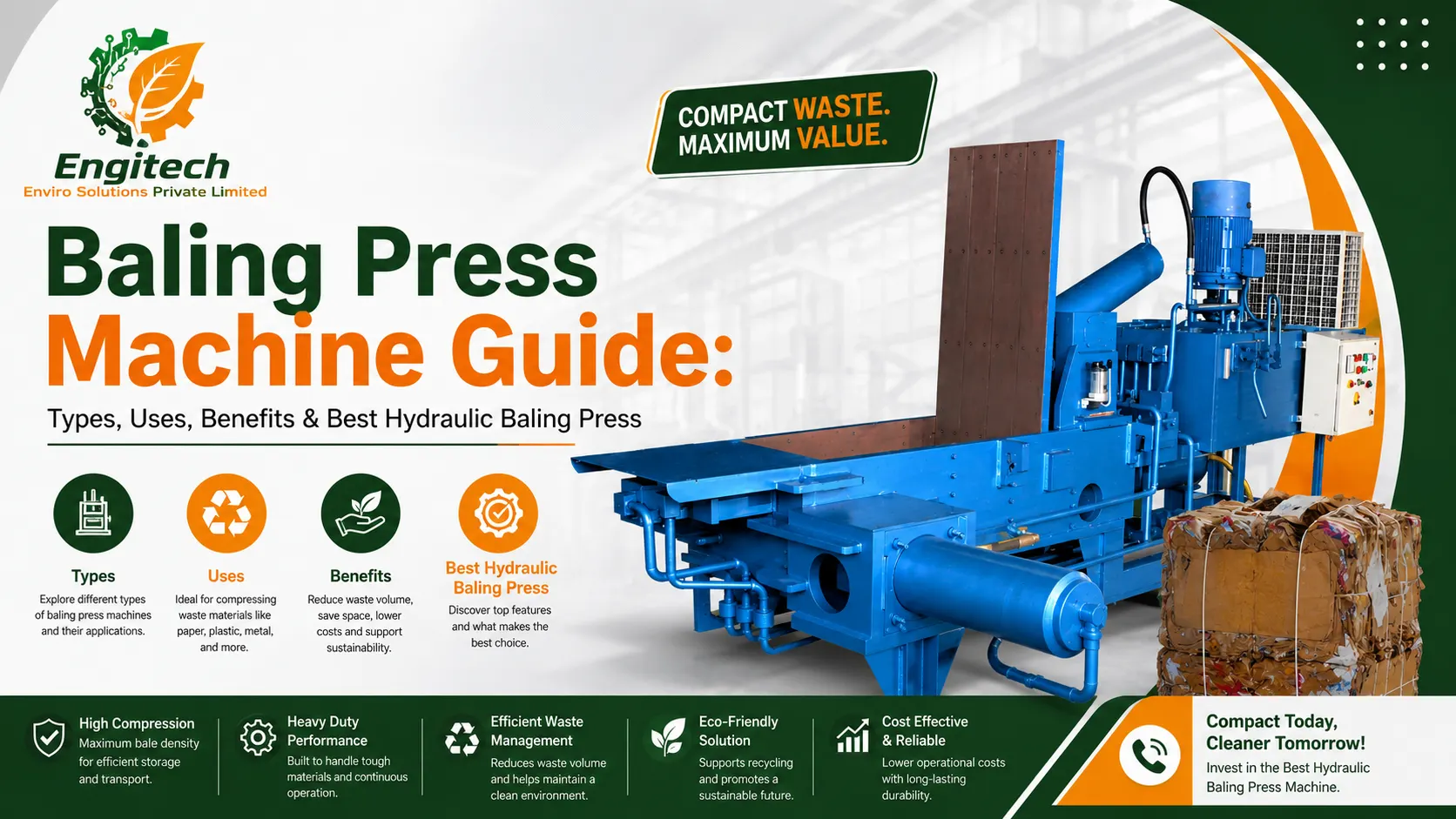
A baling press is a machine that squishes different stuff like paper, cardboard, plastic, metal scraps, and cloth leftovers into neat, tight bales. These bales are way easier to manage, store, and move around for recycling.
The baler press uses hydraulic power to squeeze up the loose bits and form them into compact blocks. Wires, straps, or ropes then secure the final product, making it easy to shift without any mess.
Around the world, many industries count on baling presses to clean up waste better and make recycling run more smoothly.
How Does a Hydraulic Baling Press Work?
A hydraulic baling press operates using a hydraulic system that generates a powerful compression force. The process generally involves the following steps:
1. Material Loading
Waste materials or recyclable products are loaded into the machine chamber manually or through automated feeding systems.
2. Compression Process
The hydraulic ram exerts pressure on the material, significantly reducing its volume.
3. Bale Formation
The material is compressed repeatedly until the desired bale density is achieved.
4. Bale Tying
The compressed bale is secured using steel wires, plastic straps, or ropes.
5. Bale Ejection
The finished bale is ejected from the chamber for storage, transportation, or recycling.
This systematic process helps businesses manage large volumes of waste efficiently and economically.
Types of Baling Press Machines
Different industries require different compaction capacities and bale sizes. Therefore, several types of baling machines are available in the market.
Vertical Baling Press
Vertical balers are among the most commonly used machines for small and medium-scale operations.
Features:
- Compact footprint
- Easy operation
- Suitable for cardboard, paper, plastic films, and textiles
- Lower installation cost
Applications:
- Retail stores
- Warehouses
- Printing industries
- Packaging facilities
Horizontal Baling Press
Horizontal balers are designed for high-volume waste processing applications.
Features:
- Continuous feeding system
- High production capacity
- Automated operation
- Large bale output
Applications:
- Recycling plants
- Waste processing centres
- Large manufacturing facilities
- Distribution centers
Automatic Baling Machine
An automatic baling machine minimises manual intervention and improves productivity.
Features:
- Automated feeding
- Automatic tying systems
- Continuous operation
- High efficiency
Applications:
- Large-scale recycling facilities
- Municipal waste management plants
- Packaging industries
Semi-Automatic Baler Press
Semi-automatic models combine automation with manual control.
Features:
- Cost-effective solution
- Moderate production capacity
- User-friendly operation
Applications:
- Small recycling businesses
- Manufacturing units
- Commercial waste management facilities
Metal Scrap Baling Press
These machines are specially designed to compress metal scrap into dense blocks.
Features:
- Heavy-duty construction
- High compression force
- Suitable for ferrous and non-ferrous metals
Applications:
- Automobile industries
- Metal recycling facilities
- Steel processing plants
Materials Processed by Baling Machines
Modern baling machines can efficiently handle a wide range of materials, including:
- Cardboard boxes
- Corrugated packaging waste
- Newspapers and magazines
- Plastic bottles
- PET containers
- Plastic films
- Textile waste
- Cotton waste
- Aluminum cans
- Steel scrap
- Agricultural residues
- Paper waste
- Foam materials
This versatility makes the hydraulic baling press an essential machine across multiple industries.
Key Components of a Baler Press
A high-quality baler press consists of several important components:
Hydraulic Power Unit
Provides the pressure required for material compression.
Compression Chamber
The section where waste materials are compressed into bales.
Hydraulic Cylinder
Converts hydraulic energy into mechanical force.
Control Panel
Allows operators to manage machine functions safely.
Bale Ejection System
Facilitates the removal of finished bales.
Safety Mechanisms
Protect operators and ensure safe machine operation.
Each component contributes to the machine’s overall performance and durability.
Major Applications of Baling Press Machines
The demand for baling presses continues to grow because of their broad industrial applications.
Recycling Industry
Recycling facilities use baling machines to process recyclable materials into transport-friendly bundles.
Manufacturing Sector
Factories generate large quantities of packaging waste and scrap materials that require compaction.
Warehouses and Logistics Centres
Storage space optimisation becomes easier with compressed waste bales.
Textile Industry
Textile manufacturers use bailing machines to compact fabric waste and cotton residues.
Agriculture Sector
Agricultural waste such as straw, hay, and crop residues can be compressed for easier storage and transportation.
Municipal Waste Management
Urban waste processing facilities utilise hydraulic baling press systems to improve waste handling efficiency.
Benefits of Using a Hydraulic Baling Press
Investing in a modern hydraulic baling press offers numerous operational and financial advantages.
Significant Space Savings
Loose waste occupies a large amount of floor space. Compression reduces waste volume dramatically, creating more usable storage space.
Reduced Transportation Costs
Dense bales allow more material to be transported in fewer trips, reducing logistics expenses.
Improved Workplace Cleanliness
Organised waste management contributes to a cleaner and safer working environment.
Enhanced Recycling Efficiency
Baled materials are easier to sort, store, and process, improving recycling workflows.
Increased Revenue from Recyclables
Compressed recyclable materials often command better market value due to easier handling and transportation.
Better Inventory Management
Compact bales help businesses organise recyclable materials more effectively.
Environmental Sustainability
Using baling presses supports recycling efforts and reduces landfill waste, contributing to environmental conservation.
Industries That Benefit from Baling Machines
Many industries rely on baler press technology to streamline waste management operations.
Industries Include:
- Recycling facilities
- Packaging industries
- Paper mills
- Printing companies
- Textile manufacturing units
- Automotive industries
- Plastic processing plants
- Warehouses
- Logistics companies
- Distribution centers
- Agricultural businesses
- Municipal waste management authorities
Factors to Consider Before Buying a Baling Press
Selecting the right baling machine requires careful evaluation of operational needs.
Material Type
Determine whether you are processing paper, plastic, metal, textile, or mixed waste.
Production Volume
Choose a machine with a suitable throughput capacity.
Bale Size Requirements
Different industries require different bale dimensions.
Automation Level
Consider manual, semi-automatic, or fully automatic systems.
Available Space
Ensure sufficient installation space for the selected machine.
Maintenance Requirements
Choose equipment with reliable service support and easy maintenance.
Power Consumption
Evaluate energy efficiency to reduce operating costs.
Future of Baling Press Technology
Technological advancements are transforming the waste management industry. Modern hydraulic baling press systems now feature:
- Smart automation
- IoT monitoring
- Remote diagnostics
- Energy-efficient hydraulic systems
- Advanced safety controls
- Automated bale tying systems
- High-density compression technology
These innovations help businesses achieve greater productivity while supporting sustainability goals.
Why Choose Engitech Enviro for Baling Press Solutions?
At Engitech Enviro, we’re dedicated to creating top-notch waste management and recycling gear for today’s industries. Our baling press, baling machine, baler press, and hydraulic baling press solutions are built for great performance, lasting durability, and smooth operation.
We aim to help businesses cut down on waste, enhance their recycling, reduce transport costs, and operate more sustainably. Thanks to our solid engineering and dependable customer service, Engitech Enviro remains a go-to brand in the industry for efficient waste management equipment.
Conclusion
A baling press is key for companies aiming for better waste handling, improved recycling, and better storage. No matter if you need a small vertical baler or a big hydraulic baling press, having the right machine boosts productivity and supports the environment, too.
With recycling becoming a top priority, up-to-date baling machines, bailing machine systems and advanced baler press technologies are crucial for effective waste management. If you team up with Engitech Enviro, you get dependable gear that helps reach your goals for both running a great business and being eco-friendly.