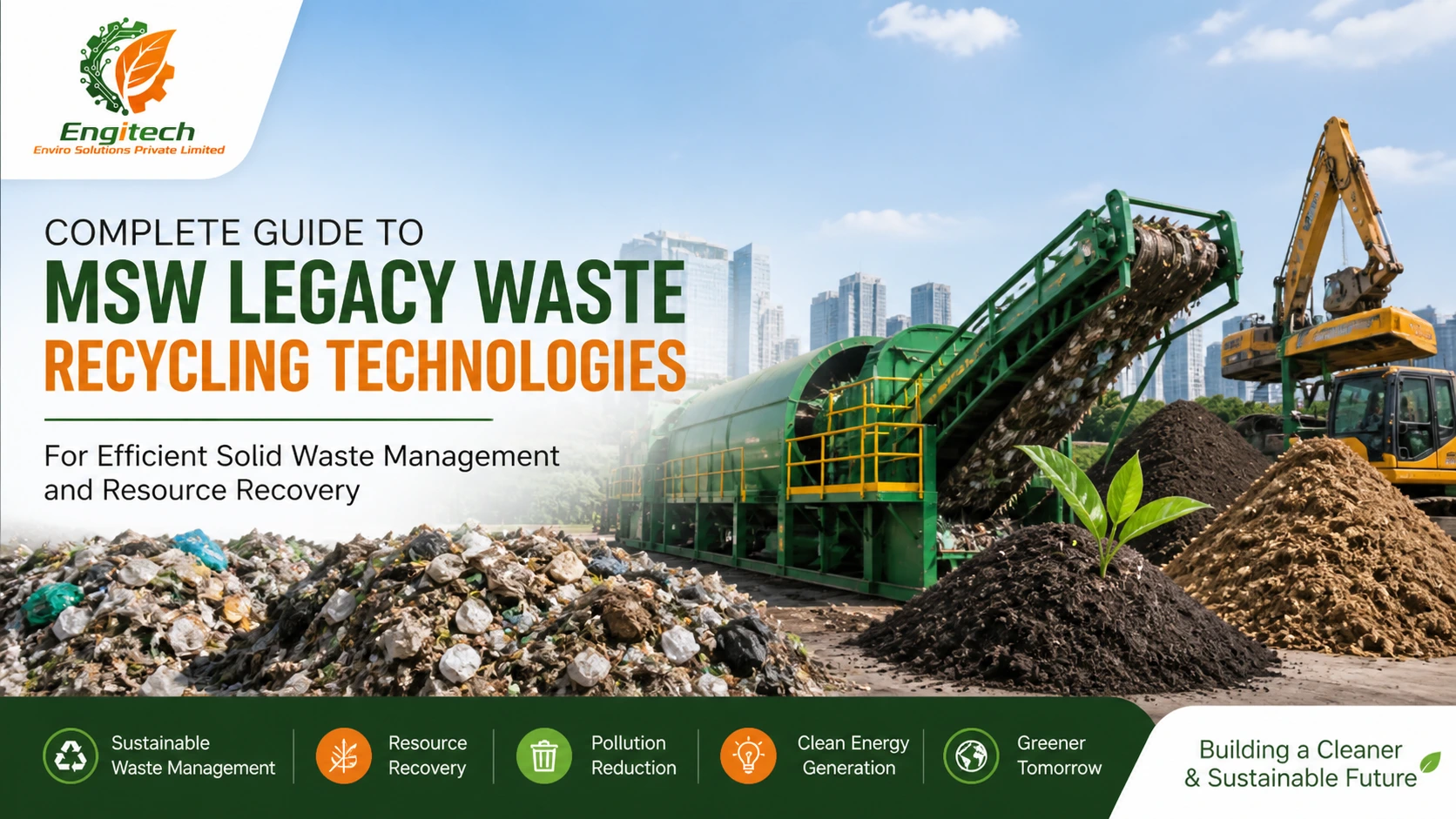
The rapid growth of cities during the past few decades has created major challenges for waste disposal systems, which have become one of the most critical environmental issues facing the world today. Cities need to develop efficient MSW Legacy Waste Recycling programs because the accumulation of waste in their areas has reached a critical point.
The world faces an urgent emergency because cities have to deal with the enormous amounts of waste that have built up through decades of improper dumping methods. The uncontained waste continues to endanger environmental ecosystems, public health, and the ability of cities to develop in a sustainable manner.
Engitech Enviro uses advanced recycling technologies to turn environmental challenges into business opportunities. This blog will help you understand MSW legacy waste meaning, modern treatment methods like biomining of legacy waste, and how Municipal Solid Waste (MSW) can be efficiently managed for resource recovery.
What is MSW (Municipal Solid Waste)?
MSW (Municipal Solid Waste) refers to the waste generated from households, commercial spaces, institutions, and public areas. It includes:
- Food and organic waste
- Plastic and packaging materials
- Paper and cardboard
- Glass and metals
- Construction debris and inert materials
When MSW is not treated properly and continues to accumulate, it turns into what we call legacy waste.
Legacy Waste Meaning Explained
The term legacy waste refers to old, accumulated waste that has been dumped over years or decades in open landfills without proper processing or segregation.
In simple terms, legacy waste is:
- A mixture of decomposed and non-decomposed waste
- Environmentally hazardous material
- A major source of pollution
For regional understanding, many users also search for legacy waste meaning in Malayalam, which essentially translates to the same concept—old waste accumulated over time that requires scientific treatment and recycling.
Why Legacy Waste is a Serious Problem
Legacy waste is not just an eyesore—it creates multiple environmental and health risks:
- Soil and groundwater contamination
- Emission of harmful gases like methane
- Spread of diseases and pests
- Fire hazards in landfill sites
- Loss of valuable land resources
This makes it essential to adopt sustainable solutions such as biomining of waste and other recycling technologies.
Biomining of Legacy Waste: A Game-Changer
One of the most effective techniques today is biomining of legacy waste, also known as bio mining of waste.
What is Biomining?
Biomining is a scientific process where old waste is excavated, segregated, and treated using biological and mechanical methods.
How It Works:
- Excavation of legacy waste from dumpsites
- Segregation using trommel screens and machinery
- Biological decomposition of organic material
- Recovery of useful materials like soil, plastics, and metals
Benefits of Biomining:
- Eco-friendly and sustainable solution
- Reduces landfill burden
- Recovers reusable resources
- Improves land quality for reuse
At Engitech Enviro, we specialize in advanced biomining of Legacy Waste Recycling solutions that maximize recovery and minimize environmental impact.
Modern MSW Legacy Waste Recycling Technologies
1. Mechanical Waste Segregation
Automated systems help separate waste into useful fractions:
- Metals
- Plastics
- Organic matter
2. Refuse Derived Fuel (RDF)
Combustible waste is converted into fuel used in:
- Cement industries
- Power plants
3. Composting Technologies
Organic waste is converted into nutrient-rich compost through:
- Aerobic composting
- Windrow composting
4. Waste-to-Energy (WTE)
Non-recyclable waste is used to generate electricity using:
- Incineration
- Pyrolysis
- Gasification
5. Land Reclamation
After processing legacy waste, land can be reused for:
- Infrastructure projects
- Parks and green spaces
- Renewable energy installations
Applications of Legacy Waste Recycling
- Smart city waste management projects
- Municipal landfill remediation
- Industrial waste recycling
- Environmental restoration programs
Benefits of MSW Legacy Waste Recycling
- Reduction in environmental pollution
- Recovery of valuable resources
- Generation of alternative energy
- Improved public health conditions
- Sustainable land utilization
Why Choose Engitech Enviro?
Engitech Enviro stands at the forefront of waste management innovation. We provide advanced and customized solutions for handling MSW Legacy Waste Recycling efficiently.
Our Strengths:
- Expertise in bio mining of waste technologies
- Customized recycling plant solutions
- End-to-end project execution
- Focus on sustainability and compliance
- High-efficiency resource recovery systems
Final Thoughts
Cities must manage their legacy waste because it has become an essential requirement for sustainable urban development. Cities can convert waste into valuable resources by understanding Legacy Waste Recycling and implementing advanced waste management solutions, which include Biomining of Legacy Waste Recycling.
The correct methods, together with appropriate technologies, enable efficient processing of Municipal Solid Waste (MSW), which decreases environmental harm and creates economic benefits.
Engitech Enviro develops trustworthy and cutting-edge solutions that establish a cleaner, greener, and sustainable future.