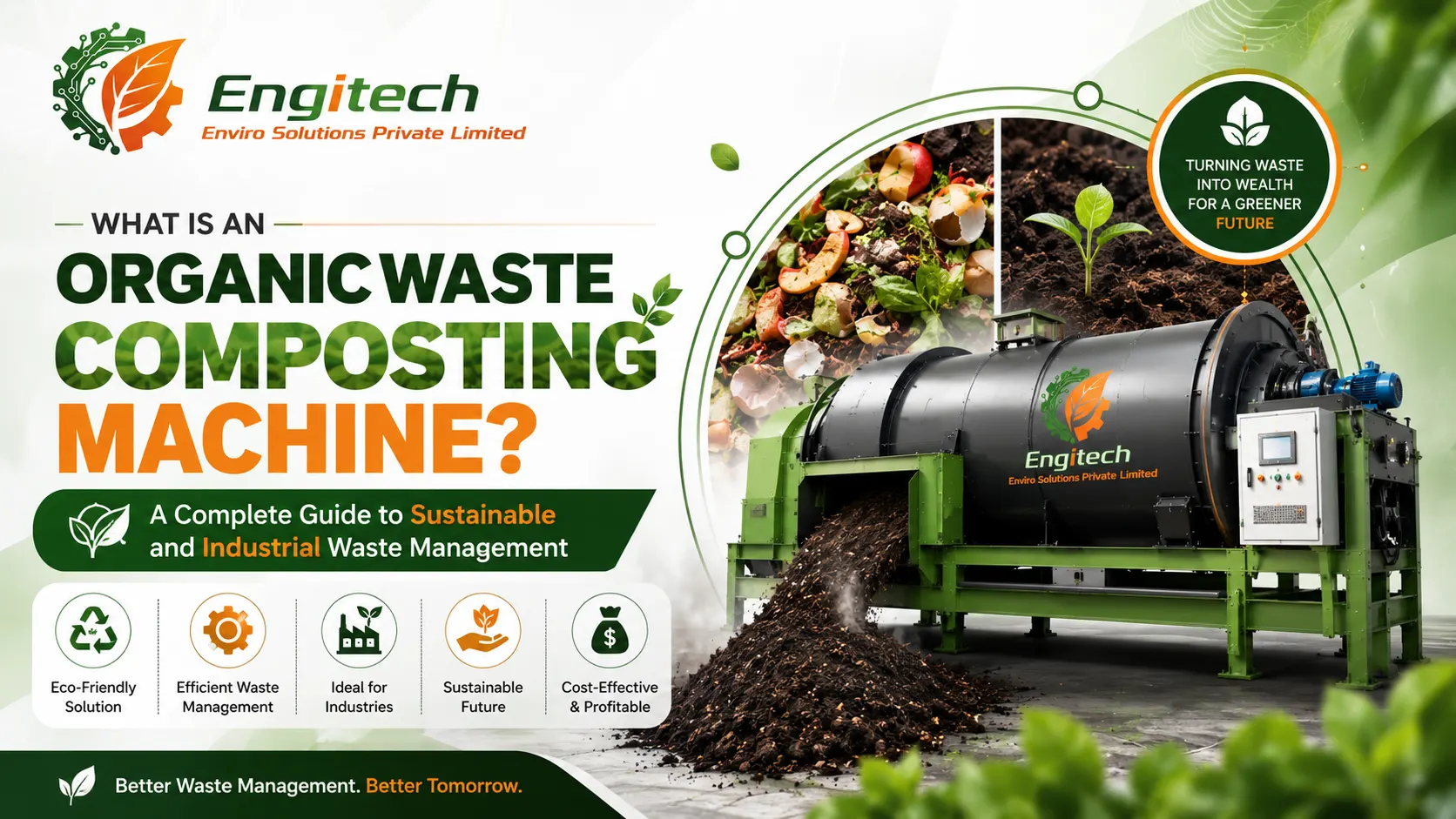
As issues related to landfill, environmental pollution, and sustainable resource management arise with growing concerns among companies and individuals, people are searching for better approaches for organic waste management. One such solution that stands out in the present scenario is Organic Waste Composting Machine. It is an advanced system for turning biodegradable waste material into compost through composting processes in a few hours.
Engitech Enviro strongly feels that organic waste management through such systems can be an environmentally friendly approach towards reducing disposal charges and producing useful compost from organic waste. In fact, Organic Waste Composting systems have become quite popular all over the world due to their wide applications in residential complexes, hotels, food industries, etc.
Understanding an Organic Waste Composting Machine
The Organic Waste Composting Machine refers to a device that is used to treat degradable organic waste composting, such as food waste, fruit waste, vegetable peelings, and various other types of degradable waste products. The use of such machines saves all this waste from being thrown away in the garbage dump and converts it into useful compost by facilitating the process of degradation.
The compost thus generated is of great benefit in gardens, landscaping works, agriculture, and horticulture activities.
The latest systems employed for composting are quite efficient and eco-friendly in nature.
Why Organic Waste Management Matters
Organic waste material is produced in tons each day due to activities at domestic levels, restaurant places, hotels, food processing industries, education centers, and even industrial locations. Organic Waste Composting Machine materials that get dumped into landfills break down through anaerobic processes, resulting in the production of methane gas.
Proper composting helps:
- Reduce landfill waste.
- Minimize environmental pollution.
- Lower waste transportation costs.
- Produce valuable organic fertilizer.
- Support sustainable waste management practices.
- Reduce greenhouse gas emissions.
This is where an organic waste converter machine becomes an essential investment for modern waste management systems.
How Does an Organic Waste Composting Machine Work?
The working principle of a waste composting machine is based on accelerating the natural biological decomposition process.
Step 1: Waste Collection
Organic waste composting, such as food leftovers, vegetable waste, fruit peels, and garden waste, is collected and fed into the machine.
Step 2: Shredding and Size Reduction
Many advanced systems include shredding mechanisms that reduce waste size, allowing microorganisms to break down the material more efficiently.
Step 3: Mixing Process
The waste is mixed with microbial cultures, enzymes, or composting agents that accelerate decomposition.
Step 4: Controlled Decomposition
The machine maintains ideal temperature, moisture, and aeration levels to support rapid composting.
Step 5: Compost Formation
Over time, the organic matter transforms into nutrient-rich compost that can be safely used for soil enrichment.
This automated process significantly reduces composting time compared to traditional composting methods.
What is an OWC Machine?
The OWC machine (Organic Waste Composting Machine) is an innovative composting device that is used to convert biodegradable waste into compost through biological treatment.
The owc machine allows you to handle the wastes directly at their sources without having to transport the wastes to landfills. The owc machine is generally installed in:
- Hotels
- Hospitals
- Residential societies
- Educational institutions
- Food courts
- Shopping malls
- Industrial facilities
- Municipal waste management projects
Types of Organic Waste Composting Machines
Different industries and users require different composting capacities. Various types of systems are available based on waste generation volume and operational requirements.
Automatic Organic Waste Converter Machine
An automatic organic waste converter machine performs most functions automatically, including mixing, aeration, and temperature control. These systems reduce manual intervention while improving composting efficiency.
Industrial Composting Machine
An industrial composting machine is designed for large-scale waste processing operations. These machines can handle substantial quantities of organic waste daily and are ideal for commercial and industrial applications.
Food Waste Composting Machine for Home
A food waste composting machine for home is compact and easy to operate. It enables households to convert kitchen waste into compost while reducing dependence on municipal waste collection systems.
Semi-Automatic Composting Systems
These systems require some manual handling while offering lower investment costs compared to fully automated models.
Applications of Organic Waste Composting Machines
The versatility of Organic Waste Composting Machine technology makes it suitable for a wide range of sectors.
Residential Communities
Apartment complexes and housing societies can significantly reduce waste disposal expenses through on-site composting.
Hotels and Restaurants
Food establishments generate large quantities of biodegradable waste daily. Composting machines help convert this waste into useful compost instead of sending it to landfills.
Educational Institutions
Schools, colleges, and universities use composting systems to manage cafeteria waste while promoting environmental awareness.
Industrial Facilities
Manufacturing units with organic waste generation can implement an industrial composting machine to achieve sustainable waste management goals.
Municipal Corporations
Cities and municipalities use large-scale composting systems to process biodegradable waste and reduce landfill dependence.
Benefits of Using an Organic Waste Converter Machine
Installing an organic waste converter provides numerous environmental and operational advantages.
Reduced Waste Disposal Costs
Organizations can significantly lower transportation and landfill expenses.
Faster Compost Production
Compared to traditional composting methods, machine-assisted composting produces compost in a shorter timeframe.
Environmentally Friendly Solution
Composting reduces methane emissions and supports circular waste management practices.
Odor Control
Modern systems are designed with odor management technologies, ensuring cleaner and more hygienic operations.
Valuable End Product
The compost produced can be used for landscaping, agriculture, gardening, and soil enhancement.
Space Efficiency
An organic waste machine occupies significantly less space than traditional composting pits.
Key Features of Modern Composting Machines
Today’s composting technologies offer advanced features that improve performance and user convenience.
Some important features include:
- Automated operation
- Energy-efficient design
- Robust construction
- Temperature control systems
- Odor management technology
- Easy maintenance
- Compact footprint
- High composting efficiency
- Environmentally friendly operation
These features make the automatic compost machine an ideal solution for modern waste management challenges.
Choosing the Right Composting Machine
Before investing in a composting system, several factors should be considered:
Waste Generation Volume
Determine the quantity of organic waste generated daily.
Available Installation Space
Choose a machine that fits the available area without disrupting operations.
Automation Requirements
Organizations seeking minimal labor involvement should consider an automatic organic waste converter machine.
Budget Considerations
Evaluate both initial investment and long-term operating costs.
Compost Quality Requirements
Ensure the selected machine produces compost suitable for the intended application.
Future of Organic Waste Management
Due to increased strictness in environmental laws and sustainability being valued, the need for more advanced composting processes is increasing steadily. Automation, microbiology innovations, and advancements in energy efficiency have made the new generation of composting machines better than the earlier ones.
In the future, some of the improvements to look forward to include the development of monitoring tools, Internet of Things integration, energy efficiency, and higher composting outputs.
Conclusion
An Organic Waste Composting Machine can be considered among the most efficient measures to manage biodegradable waste effectively. No matter whether it is a domestic food waste composter, a small owc machine for residential areas, or an industrial composter, these waste converters are essential in making our environment more sustainable by minimizing waste in landfills.
Here at Engitech Enviro, we have been trying to assist you in achieving a more environmentally friendly approach towards waste disposal. With the purchase of a proper organic waste converter machine, not only will you be doing your part in ensuring a cleaner environment, but you will also save money on disposal services.