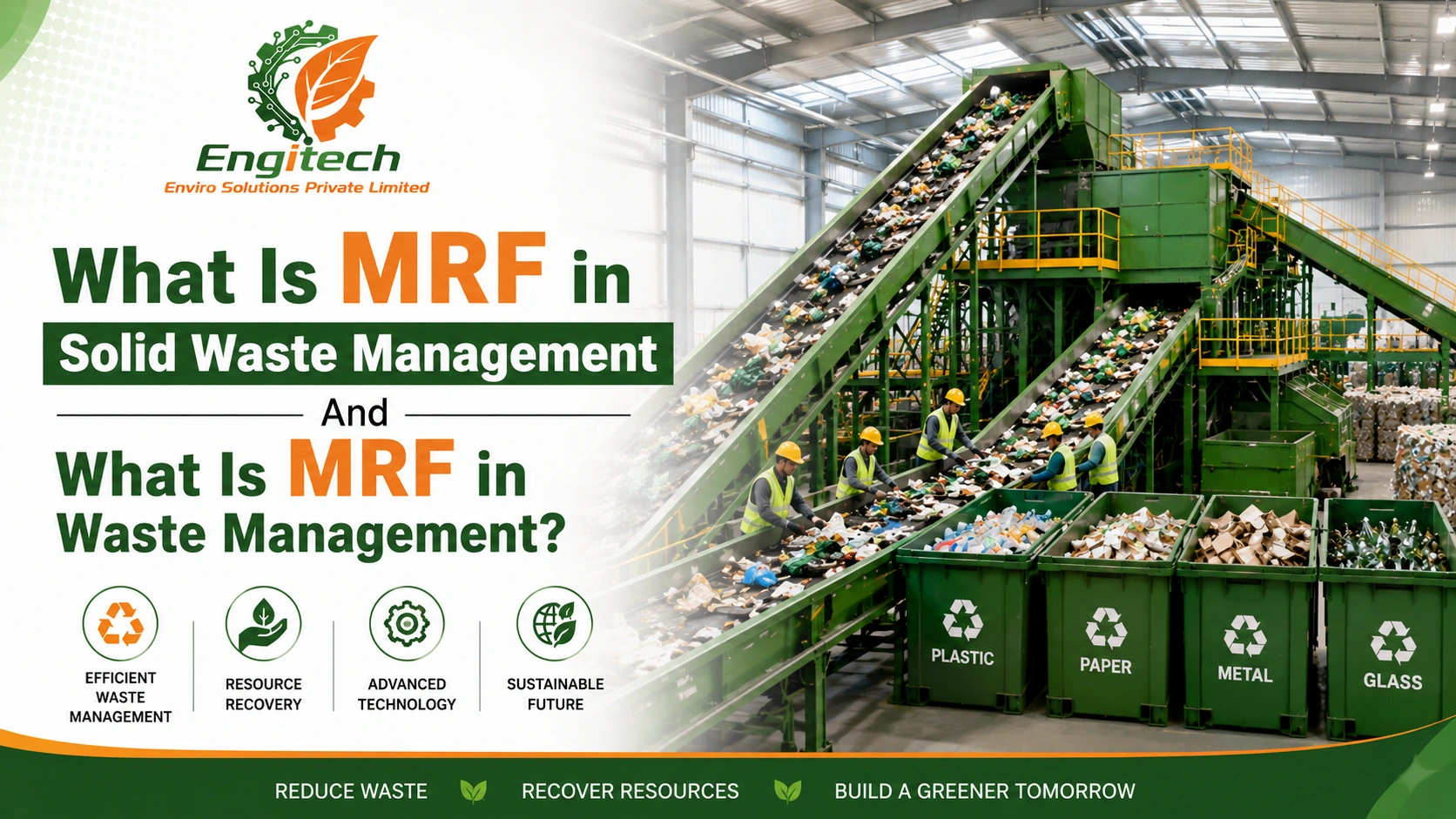
With growing populations in the cities, the generation of Solid Waste Management is also happening daily at an unparalleled pace. Efficient management of such wastes has been posed as the greatest challenge to urban areas, industries, and municipalities across the globe. One of the best ways invented to solve such a problem was the establishment of an MRF (Material Recovery Facility).
The experts of Engitech Enviro strongly believe in the segregation and recycling process of sustainable waste management. In this detailed guide on waste management, we will learn about material recovery facilities in waste management, how it helps in solid waste management, the advantages, their mechanism, and much more.
Understanding MRF Meaning
Before proceeding with the use of this facility, we should first get familiar with the MRF definition.
MRF is an abbreviation that stands for Material Recovery Facility – a unique plant where various wastes or separated wastes are taken, sorted out, and then processed for recycling purposes or any other processing. Rather than sending such valuable substances to landfills, MRF makes it possible to retrieve paper, plastic, metals, and glass, among others.
To put it simply, a material recovery facility is like a mediator between Solid Waste Management facilities and recycling facilities.
What Is MRF in Waste Management?
Many wonder what is MRF in waste management and its significance.
MRF stands for Materials Recovery Facility, which refers to facilities that segregate recyclables from municipal waste. The main aim is to extract the maximum possible resources, thereby reducing the amount of waste disposed of at landfills.
Waste segregation in MRF waste management systems involves a blend of both manual segregation and technological innovations like conveyors, magnetic separation, air classification, optical sorting, and sieving.
This ensures that valuable resources are extracted and contributes to environmental sustainability efforts.
What Is Material Recovery Facility in Solid Waste Management?
The concept of a material recovery facility in solid waste management means a facility whose functions are essential when managing municipal solid waste.
Once household waste, business waste, and institutional waste are generated, a good share of the waste comprises recyclable components that could be used to make new things and not disposed of in landfills. These are the types of waste streams managed by the MRF.
This waste is separated, and the recyclable components are sent to recycling facilities and turned into new goods. The process helps to conserve natural resources and reduce greenhouse gas emissions, among other benefits.
The absence of such a material recovery facility in solid waste management leads to massive amounts of recyclable waste being disposed of in the landfill.
How Does an MRF Facility Work?
A modern MRF facility follows a systematic process to recover valuable resources from waste.
Waste Reception
Collected waste arrives at the facility and is unloaded in designated receiving areas.
Preliminary Inspection
Large contaminants, bulky items, and hazardous materials are removed before sorting begins.
Mechanical Sorting
Conveyor systems transport waste through various sorting equipment designed to separate materials based on size, weight, density, and composition.
Magnetic Separation
Ferrous metals are extracted using powerful magnetic separators.
Air Classification
Light materials such as plastic films and paper are separated from heavier materials.
Optical Sorting
Advanced sensors identify and separate different types of plastics and recyclable materials.
Baling and Storage
Recovered materials are compressed into bales and stored until shipment to recycling facilities.
This organized process makes an MRF center an essential component of sustainable Solid Waste Management infrastructure.
Importance of MRF Waste Management
Effective MRF waste management provides numerous environmental and economic benefits.
Reduces Landfill Waste
One of the primary advantages of an MRF is its ability to divert large amounts of waste away from landfills.
Conserves Natural Resources
Recovered materials reduce the need for extracting raw resources from nature.
Supports Recycling Industries
MRFs provide a steady supply of recyclable materials to manufacturing and recycling sectors.
Reduces Pollution
Proper waste sorting minimizes soil, air, and water pollution caused by improper disposal.
Creates Employment
Material recovery facilities generate jobs in waste collection, sorting, processing, and recycling operations.
Encourages Circular Economy
Recovered resources are reintroduced into production cycles, reducing waste generation and promoting sustainability.
Types of Material Recovery Facilities
Different types of material recovery facility systems are used depending on the nature of the waste stream.
Clean MRF
Processes source-separated recyclable materials that have already been segregated by households or businesses.
Dirty MRF
Handles mixed municipal waste and separates recyclable materials after collection.
Hybrid MRF
Combines features of both clean and dirty MRF systems to maximize recovery efficiency.
Each type of MRF facility is designed to achieve specific waste management objectives.
MRF Center and Its Role in Smart Cities
Modern smart cities increasingly depend on efficient MRF centers to achieve sustainability goals.
These facilities help municipalities:
- Improve waste segregation rates
- Increase recycling efficiency
- Reduce landfill dependency
- Lower carbon emissions
- Generate revenue from recovered materials
- Promote environmental awareness
As cities continue to expand, investment in advanced MRF infrastructure becomes essential for sustainable urban development.
MRF Meaning in Waste Management
mrf meaning in waste management definition in relation to Solid Waste Management cannot be taken to mean simply waste sorting. Instead, it encompasses an overall approach to recycling resources, minimizing environmental effects, and fostering circular economies.
Currently, both governments and environmental organizations across the globe are promoting the establishment of MRF centers as part of integrated waste management systems. This is because such centers are essential in converting waste into resources.
MRF Meaning in Construction
However, the abbreviation mrf meaning in construction, can on some occasions be linked with the existence of recovery facilities in relation to construction and demolition wastes recycling projects.
During construction, large amounts of construction debris, including concrete, wood, metal, plastics, etc., are produced. There exist recovery facilities to help recover materials from construction debris for recycling and reuse purposes.
While there is a wide application of the abbreviation MRF in the field of municipal solid waste management, the principles of MRF have been applied in construction and demolition waste recycling programs.
Future of Material Recovery Facilities
Material recovery facility processes have been affected by technological advancements. AI technology, robotics, machine learning, and sorting technologies have all boosted recovery and efficiency rates.
Smart, fast, and accurate material detection has been achieved by advanced MRFs. Technology has helped Solid Waste Management firms meet their recycling targets more efficiently while cutting costs.
Due to increased pressure from environmental policies and sustainability goals, MRFs will remain crucial to waste reduction and resource conservation efforts.
Conclusion
An understanding of MRF Solid Waste Management is key to comprehending the essence of recycling and resource recovery in contemporary society. The material recovery facility plays a pivotal role in sustainable waste management through separating the recyclables from waste streams and ensuring they can be reused.
At Engitech Enviro, we appreciate the necessity of effective MRF waste management in contributing to clean cities and reduced landfills that help achieve environmental sustainability. Regardless of whether one talks about the MRF center, advanced MRF, or the material recovery facility as a whole in solid waste management, all play a key role in shaping a better future.
As communities move towards adopting sustainable methods in waste management, MRF facilities will play a more important role in turning waste into resources.